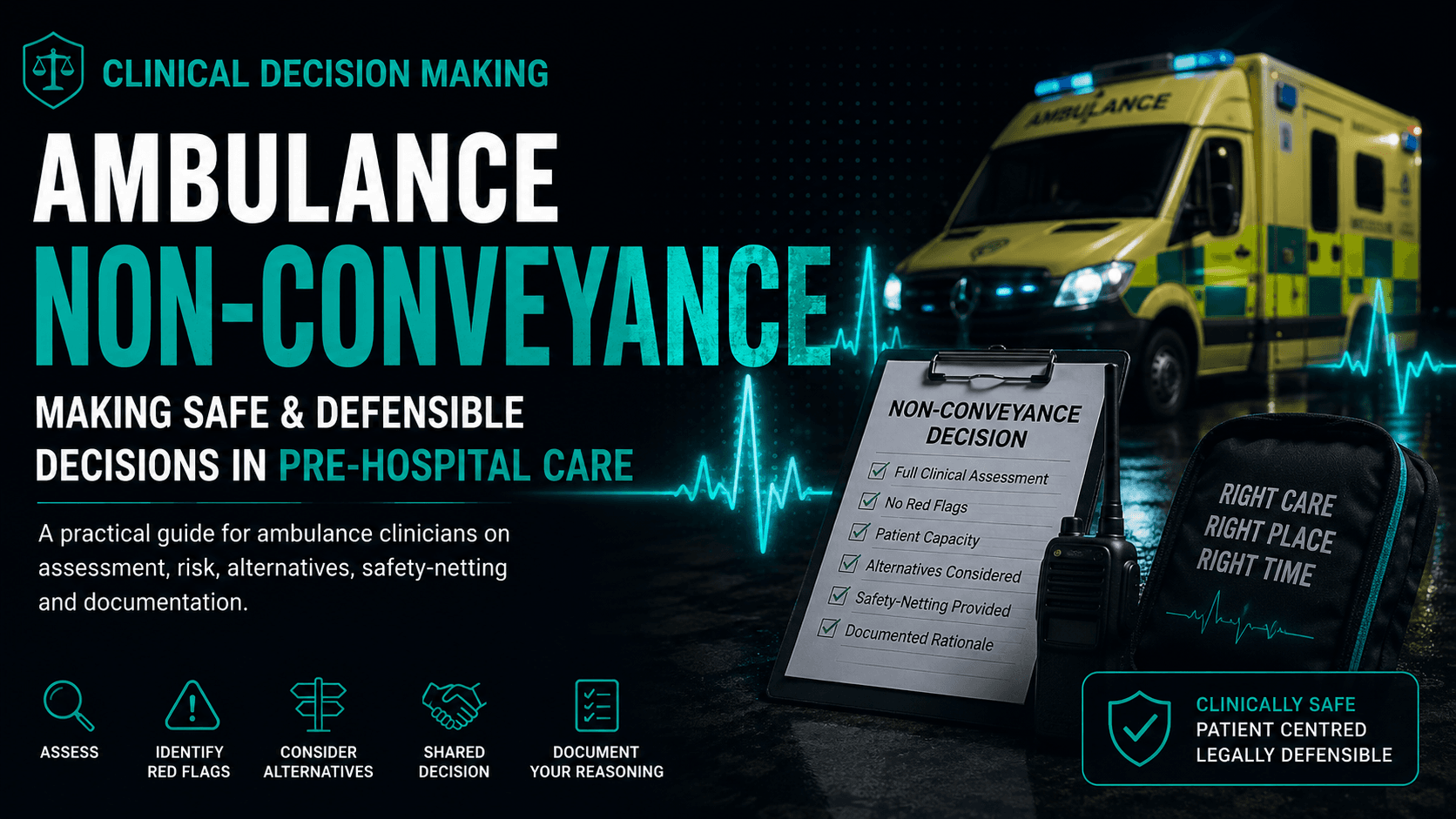
Ambulance Non-Conveyance: Making Safe, Defensible Decisions in Pre-Hospital Care
Non-conveyance has become an increasingly important part of modern UK ambulance practice. With growing pressure across urgent and emergency care, ambulance clinicians are increasingly expected to identify patients who can safely receive care closer to home or through alternative pathways.
Ambulance Non-Conveyance: Making Safe, Defensible Decisions in Pre-Hospital Care
When Is It Actually Safe to Leave a Patient at Home?
For ambulance clinicians, deciding not to convey a patient can sometimes require more clinical judgement than transporting them to hospital.
A patient may look well. Their observations may be within normal limits. Their symptoms may have improved before the ambulance arrived.
But does that mean they are safe to remain at home?
Non-conveyance has become an increasingly important part of modern UK ambulance practice. With growing pressure across urgent and emergency care, ambulance clinicians are increasingly expected to identify patients who can safely receive care closer to home or through alternative pathways.
However, reducing unnecessary hospital attendance must never mean lowering the threshold for safe clinical decision-making.
A good non-conveyance decision should be clinically appropriate, patient-centred, supported by a robust assessment and clearly documented.
What Is Non-Conveyance?
Non-conveyance describes an ambulance attendance where the patient is assessed but is not subsequently transported by the ambulance service to hospital or another healthcare facility.
This can include patients who:
are assessed and treated at scene are referred to another healthcare professional or service are given appropriate self-care advice remain at home with a suitable safety-netting plan decline further assessment or transport despite clinical advice
These situations are not all the same.
There is an important difference between a clinician determining that hospital conveyance is not required and a patient refusing recommended care.
Understanding that distinction is essential for both patient safety and documentation.
Why Non-Conveyance Matters More Than Ever
The role of UK ambulance services continues to evolve.
Ambulance clinicians are no longer simply expected to assess, stabilise and transport every patient to an Emergency Department.
NHS England's urgent and emergency care strategy has placed increasing emphasis on paramedic-led care in the community, See & Treat, alternative pathways and avoiding unnecessary hospital conveyance where clinically appropriate.
This can provide significant benefits.
Patients may avoid long waits in Emergency Departments, unnecessary investigations and the risks associated with hospital admission.
For frail or elderly patients in particular, avoiding unnecessary hospital attendance may prevent additional problems such as deconditioning, confusion and disruption to existing care arrangements.
But there is an important principle:
The aim should never simply be to avoid conveyance. The aim is to get the patient to the right care, in the right place, at the right time.
Sometimes that place is home.
Sometimes it is an Urgent Treatment Centre, Same Day Emergency Care service, GP, community team or specialist pathway.
And sometimes the safest place remains the Emergency Department.
The Non-Conveyance Mindset
One of the biggest traps in non-conveyance decision-making is starting with the question:
"Can I leave this patient at home?"
A safer approach is:
"What could be happening to this patient, and have I gathered enough information to safely determine the most appropriate next step?"
This subtle difference matters.
The clinician should actively search for reasons not to leave the patient at home rather than simply looking for reassurance that supports a non-conveyance decision.
Normal observations alone do not necessarily exclude serious illness.
- Start With a Full Clinical Assessment
A non-conveyance decision should follow an appropriate clinical assessment.
Depending on the presentation, this may include:
presenting complaint and history history of the current episode relevant medical and surgical history prescribed and non-prescribed medication allergies baseline functional status appropriate physiological observations relevant physical examination neurological assessment where indicated ECG where clinically appropriate blood glucose where indicated temperature pain assessment consideration of injury mechanism social and safeguarding assessment mental capacity assessment where relevant
The assessment should be appropriate to the patient's presentation rather than simply completing observations because they appear on an electronic patient record.
Ask yourself:
Have I actually investigated why this happened?
- Look Beyond the Numbers
One of the most dangerous assumptions in pre-hospital care is:
"Their observations are normal, therefore they are fine."
Physiological observations are an important part of assessment, but they are only one component.
A patient can have apparently reassuring observations while still experiencing significant pathology.
Consider the entire clinical picture:
Appearance → History → Examination → Observations → Risk factors → Clinical trajectory
For example, an older patient who experienced an unexplained collapse but now has normal observations still requires investigation into why they collapsed.
The normal observations tell you what their physiology looks like now.
They do not necessarily explain what happened 30 minutes ago.
- Establish What Has Changed
A useful question in pre-hospital assessment is:
"What is different today?"
This is particularly valuable when assessing patients with multiple long-term conditions.
Determine:
What is normal for this patient? What changed? When did it change? Was the onset sudden or gradual? Are symptoms improving, worsening or fluctuating? Has this happened before? If so, was the previous cause established? Is there a plausible explanation for today's presentation?
Understanding the patient's baseline can significantly change the interpretation of your findings.
- Actively Search for Red Flags
Before considering non-conveyance, actively look for features suggesting that further assessment is required.
Depending on the presentation, these could include:
abnormal or deteriorating observations unexplained syncope or collapse new neurological deficit ongoing or concerning chest pain significant breathing difficulty new confusion or altered consciousness severe or unexplained pain significant bleeding concerning abdominal findings suspected sepsis or serious infection significant mechanism of injury anticoagulant use following relevant trauma recurrent presentations without an established explanation safeguarding concerns inability to mobilise at normal baseline significant deterioration from usual function
This list is not exhaustive.
The relevant red flags will depend on the presenting complaint, patient and clinical circumstances.
Current JRCALC guidance and local ambulance service policies should always inform practice.
- Consider the Patient's Clinical Trajectory
A snapshot assessment can be misleading.
Ask:
Where is this patient heading?
A patient who currently appears stable but has progressively worsening symptoms over several hours may require a very different disposition from someone whose symptoms have completely resolved following an identifiable and reversible problem.
Consider whether the patient is:
Improving → Stable → Fluctuating → Deteriorating
Clinical trajectory can be just as important as the individual observation values.
- Capacity Is Not Just a Tick Box
Mental capacity is particularly important when a patient declines recommended assessment or conveyance.
Under the Mental Capacity Act 2005, adults should be presumed to have capacity unless there is evidence otherwise.
But capacity is decision-specific and time-specific.
Where there is reason to question capacity, clinicians should consider whether the patient can:
understand the relevant information retain that information long enough to make the decision use or weigh that information when making their decision communicate their decision
Factors including intoxication, hypoxia, head injury, dementia, delirium, learning disability or acute mental health crisis may affect decision-making.
However, the presence of one of these factors does not automatically mean that the patient lacks capacity.
Equally, a patient making a decision that the clinician considers unwise does not automatically lack capacity.
- Non-Conveyance Is Different From Refusal
This distinction should be clear.
Clinician-led non-conveyance
Following assessment, the clinician determines that ambulance conveyance is not currently required and an appropriate alternative plan is agreed.
Patient refusal
The clinician recommends further assessment, treatment or conveyance but the patient declines.
The documentation required may therefore be very different.
If a patient refuses recommended conveyance, the clinical record should make clear:
what was recommended why it was recommended the risks explained to the patient assessment of capacity where relevant the patient's decision any alternative plan offered safety-netting provided
Simply recording "patient refused" provides very little information about the clinical decision-making that took place.
- Use Alternative Care Pathways
Non-conveyance should not necessarily mean:
"We're leaving and you're on your own."
Modern ambulance practice increasingly involves connecting patients with other services.
Depending on local availability, this may include:
GP or out-of-hours GP Urgent Treatment Centres Same Day Emergency Care community nursing teams urgent community response falls services frailty teams mental health crisis services pharmacy specialist clinical advice maternity services palliative or end-of-life teams
Local pathways vary significantly.
Clinicians should understand which services operate in their area, their referral criteria and their operating hours.
- Safety-Netting Is a Clinical Intervention
"Call us back if you get worse."
That may be appropriate in some circumstances, but good safety-netting should usually be more specific.
Patients should understand:
What should I expect?
Explain the expected progression of the problem where appropriate.
What should concern me?
Give specific warning signs relevant to their presentation.
What should I do?
Explain whether they should contact their GP, NHS 111, another service or 999.
How quickly should I act?
Make clear which symptoms require immediate action.
Good safety-netting acknowledges an important reality:
Clinical conditions evolve.
The patient you assess at 14:00 may not be the same patient at 20:00.
- Think About the Environment
A clinically appropriate non-conveyance decision can become unsafe because of the patient's circumstances.
Consider:
Does the patient live alone? Can they mobilise safely? Can they access food and fluids? Can they obtain their medication? Is someone available to monitor them? Can they understand and follow the safety-netting advice? Do they have access to a telephone? Can they contact help if their condition deteriorates? Are there safeguarding concerns? Is the home environment safe?
Clinical risk and social risk frequently overlap.
Documentation: If It Isn't Written Down...
Documentation is one of the most important components of non-conveyance.
A good clinical record should allow another clinician to understand:
What you found → What you considered → What you did → Why you made the decision → What happens next
Rather than writing:
"Patient well. Obs normal. Happy to remain at home. Safety netted."
Consider whether your documentation demonstrates:
presenting complaint relevant positive and negative findings observations and trends relevant examination differential diagnoses considered red flags assessed treatment provided response to treatment capacity where relevant clinical advice obtained alternative pathways considered agreed management plan specific safety-netting patient understanding and agreement
Documentation should demonstrate your clinical reasoning, not merely the outcome.
The "Would I Be Comfortable?" Test
Before leaving scene, ask yourself:
Have I adequately explained what happened? Have I excluded the important time-critical possibilities within my scope? Are there any unresolved red flags? Is this patient's current condition consistent with their normal baseline? Do they have capacity to make the relevant decisions? Is there a clear ongoing care plan? Does the patient understand when and how to seek further help? Have I documented why non-conveyance is appropriate?
And finally:
If this patient deteriorated later today, could I clearly explain why my decision was reasonable based on the information available at the time?
That final question can be extremely useful.
Clinical decisions should not be judged solely with hindsight. They should be based on whether the assessment, reasoning and plan were reasonable given the information available at the time.
When in Doubt, Escalate
Seeking senior clinical advice is not a sign of poor clinical practice.
It can be evidence of good clinical judgement.
Where available, clinicians may be able to access:
clinical support desks senior paramedics advanced practitioners specialist clinicians GPs mental health professionals community services hospital specialties
NHS England's current urgent and emergency care strategy specifically supports greater access to multidisciplinary decision-making and "call before convey" models to help clinicians identify safe alternatives to Emergency Department attendance.
Use the support available to you.
Final Thoughts
Non-conveyance is not the absence of care.
Done properly, it is an active clinical intervention involving assessment, risk management, shared decision-making, referral and safety-netting.
As ambulance services increasingly deliver urgent care in the community, clinicians will continue to make more complex decisions about which patients genuinely require hospital assessment.
The objective is not:
"How many patients can we leave at home?"
It should always be:
"What is the safest and most appropriate care pathway for this patient?"
Sometimes the answer will be the Emergency Department.
Sometimes it will be another healthcare service.
And sometimes, following a thorough assessment and appropriate safety-netting, the safest place for the patient really is their own home.
Key Takeaways Non-conveyance should follow an appropriate clinical assessment. Normal observations do not automatically mean a patient is safe to remain at home. Consider clinical trajectory, not just a snapshot of the patient. Actively identify red flags and relevant differential diagnoses. Distinguish clinician-led non-conveyance from patient refusal. Consider mental capacity where appropriate. Use alternative pathways and senior clinical support. Social circumstances can change the safety of a clinical decision. Safety-netting should be specific and meaningful. Document the clinical reasoning behind your decision. Clinical Disclaimer
This article is intended for education and professional development only and does not replace current JRCALC guidance, local ambulance service policies, clinical pathways, scope of practice or individual clinical judgement. Clinicians should always refer to the most current guidance available within their organisation.
Clinical insights, straight to your inbox
Get new articles, CPD tips and product updates. No spam — unsubscribe anytime.
Related articles
 Compliance & Governance
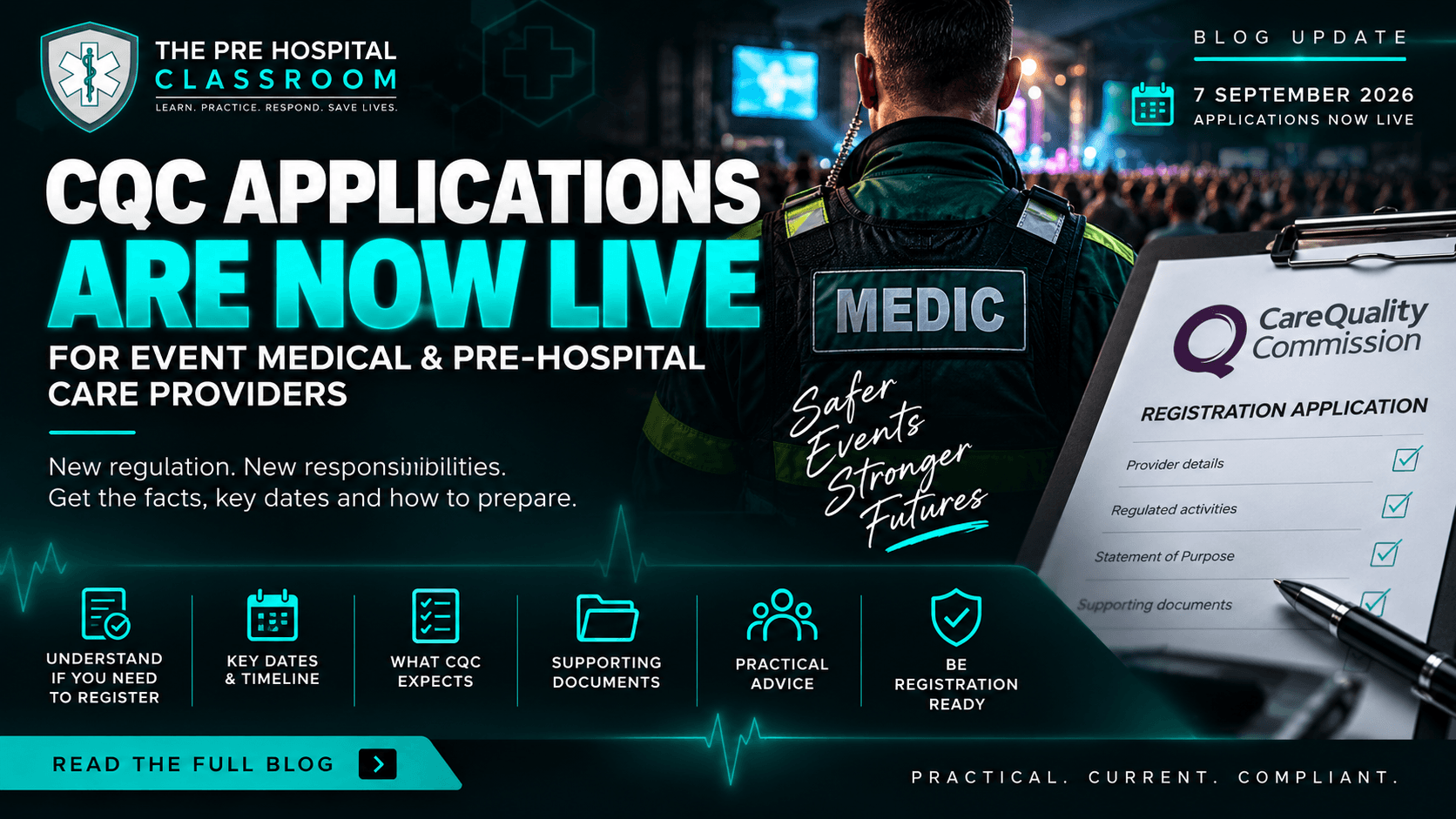
CQC Applications Are Now LIVE for Event Medical Providers: What You Need to Know
From 7 September 2026, providers delivering healthcare and treatment at sporting and cultural events that meets the definition of the regulated activity Treatment of Disease, Disorder or Injury (TDDI) can begin submitting their applications to the Care Quality Commission.
 Compliance & Governance
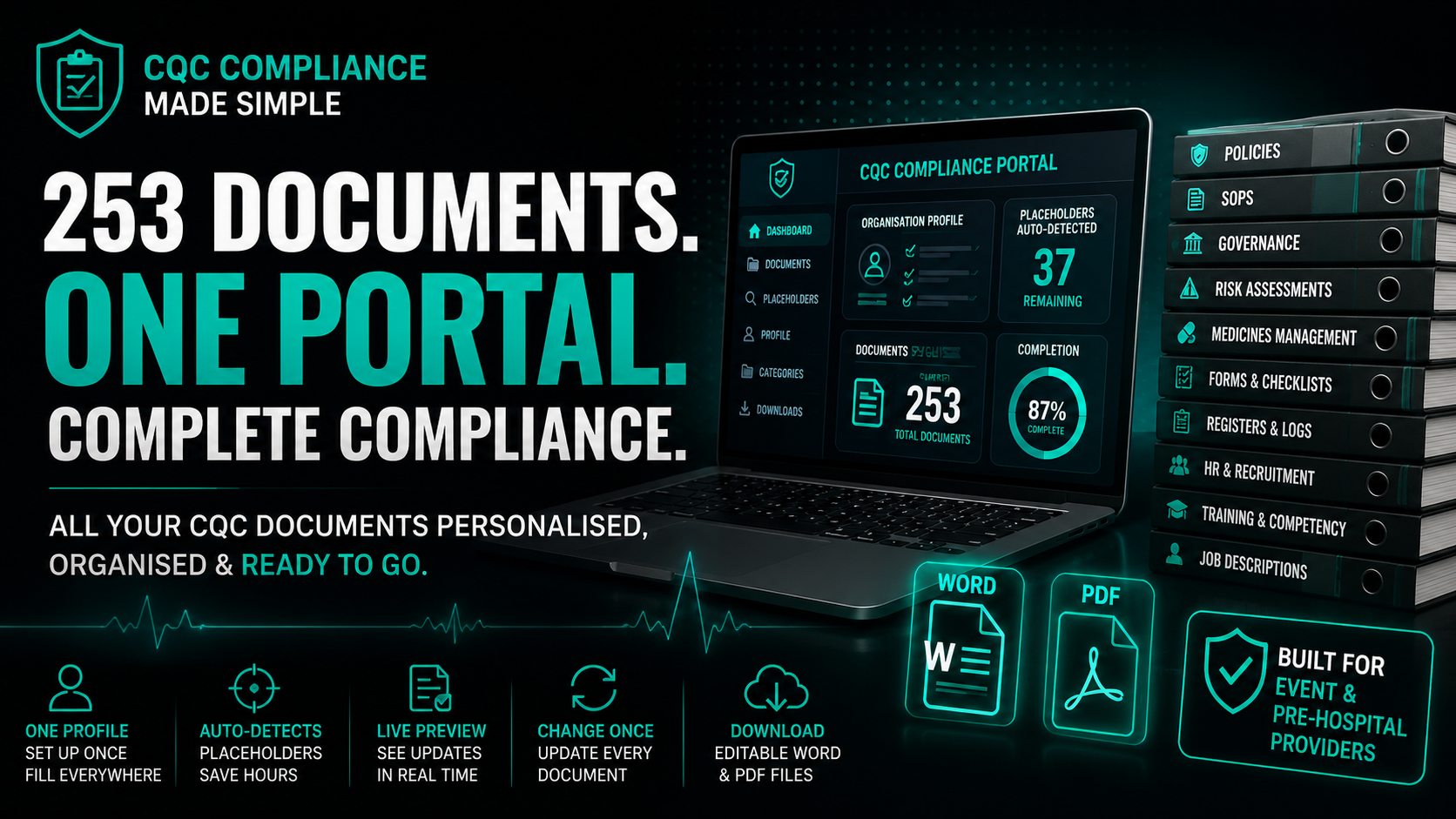
CQC Compliance Without the Document Headache: Introducing Our 253-Document Compliance Suite & Portal
Preparing for CQC registration can mean building and personalising hundreds of policies, SOPs, governance documents, risk assessments, forms, registers and workforce records. Our CQC Compliance Suite combines 253 professional documents with a purpose-built online portal that helps personalise your entire library from one organisation profile.
 Compliance & Governance
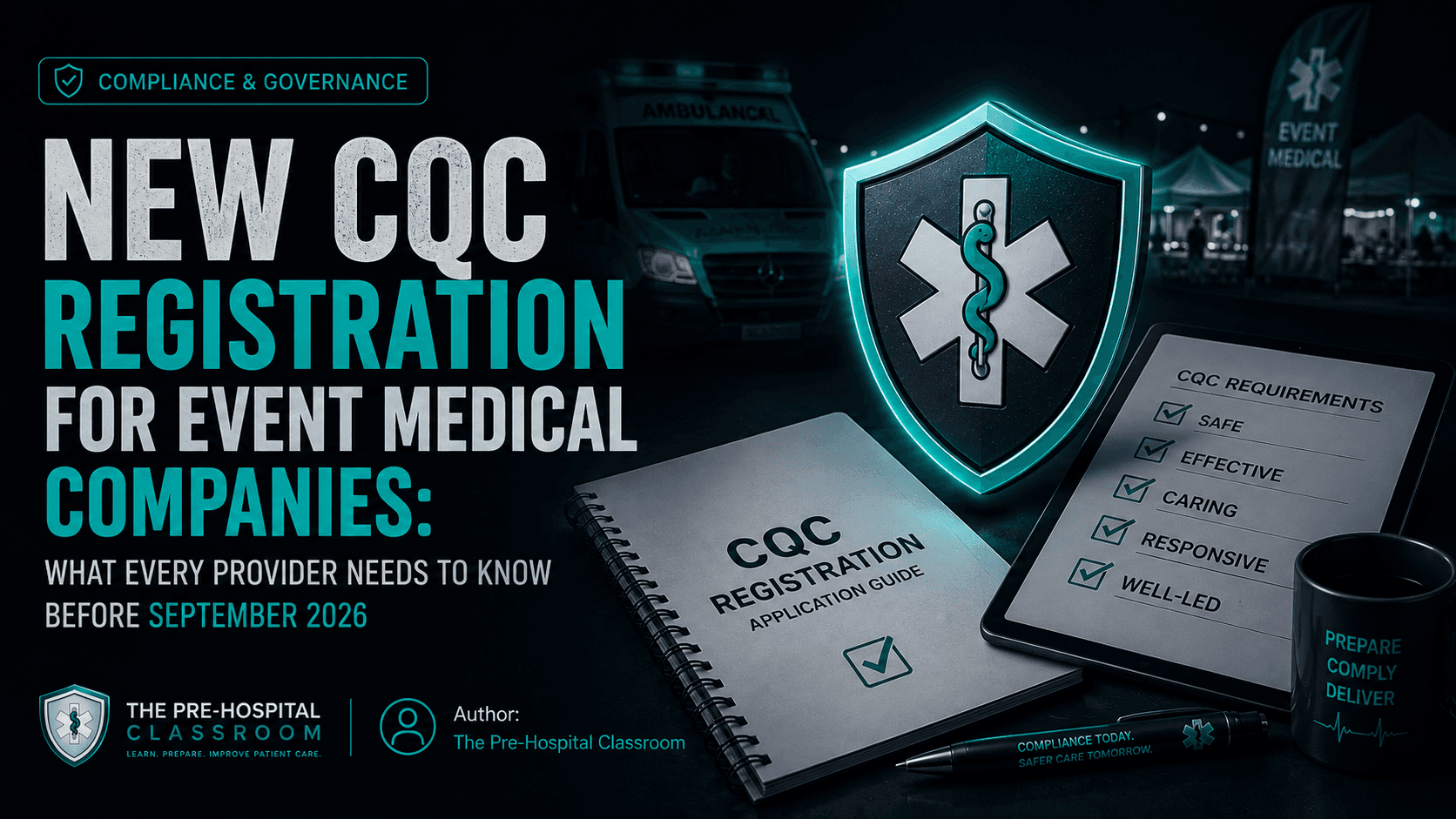
New CQC Registration for Event Medical Companies: What Every Provider Needs to Know Before September 2026
From 7 September 2026, event medical providers can apply for CQC registration. Here's what's changing, the key dates, and how to prepare your governance — without the consultancy price tag.