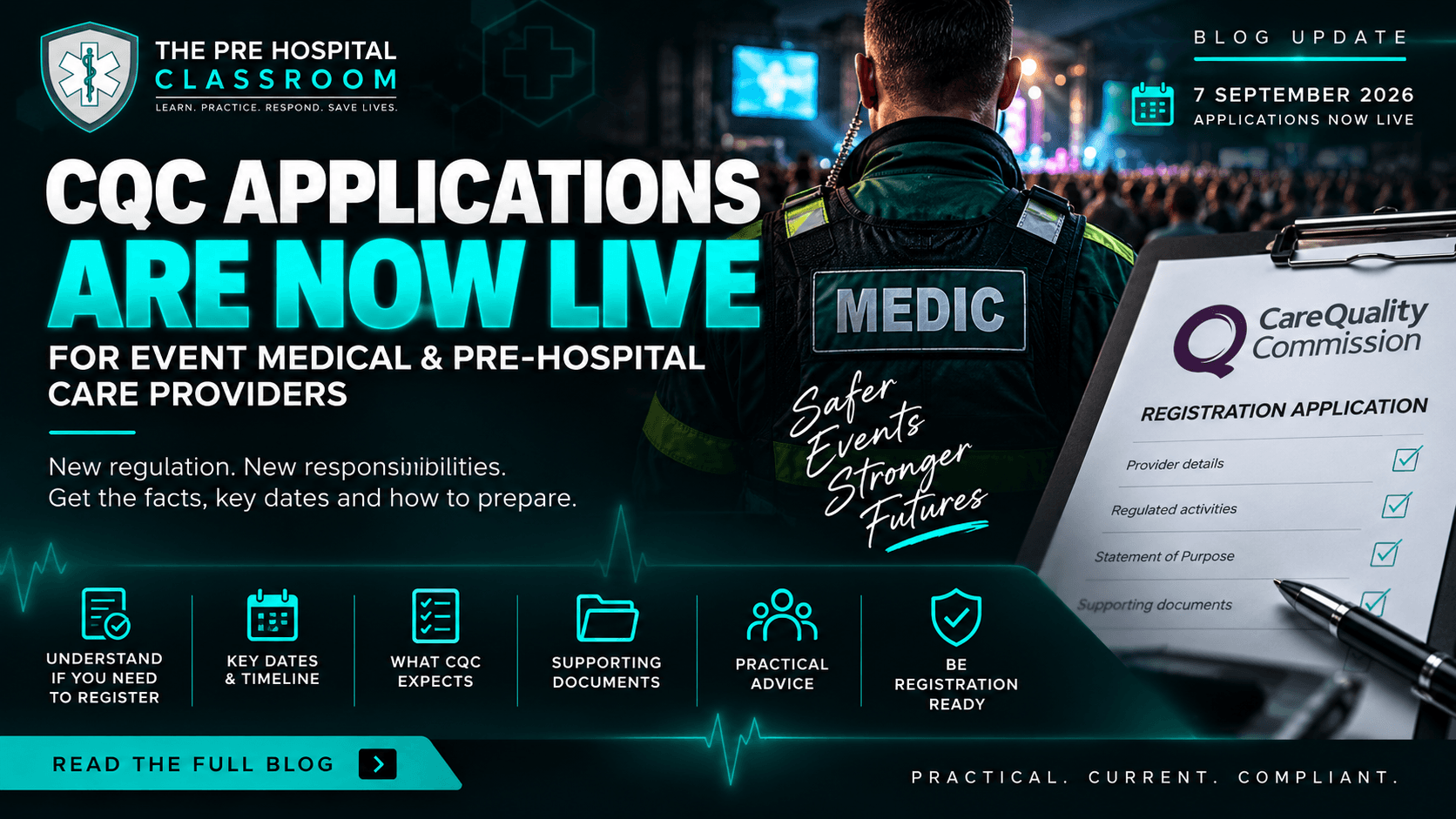
CQC Applications Are Now LIVE for Event Medical Providers: What You Need to Know
From 7 September 2026, providers delivering healthcare and treatment at sporting and cultural events that meets the definition of the regulated activity Treatment of Disease, Disorder or Injury (TDDI) can begin submitting their applications to the Care Quality Commission.
CQC Applications Are Now LIVE for Event Medical Providers: What You Need to Know
8 September 2026 · Compliance & Governance · 8 min read
For event medical and pre-hospital care providers across England, one of the biggest regulatory changes the sector has seen has now reached a major milestone.
CQC registration applications for affected event healthcare providers are now open.
From 7 September 2026, providers delivering healthcare and treatment at sporting and cultural events that meets the definition of the regulated activity Treatment of Disease, Disorder or Injury (TDDI) can begin submitting their applications to the Care Quality Commission.
This follows changes to the Health and Social Care Act 2008 (Regulated Activities) Regulations 2014 which removed two previous exceptions relating to healthcare delivered at sporting and cultural events.
For many event medical companies, this represents a fundamental change.
Until now, healthcare delivered solely within many event sites could fall outside CQC regulation because of specific exemptions.
That position has changed.
Why Has Event Medical Care Been Brought Into CQC Regulation?
The changes follow recommendations arising from the Manchester Arena Inquiry, which considered the standards and regulation of healthcare provision at events.
The Inquiry recommended consideration be given to the standard of healthcare provided at events, whether those standards should sit within statutory regulation, and how they should be enforced.
CQC has also stated that its regulatory work has identified significant risks within independent medical care at temporary sporting and cultural events, including cases where care resulted in serious harm.
Following changes introduced by government, healthcare delivered at event sites is no longer automatically outside CQC's scope simply because it takes place at an event.
The question providers now need to ask is:
Are we carrying on the regulated activity of Treatment of Disease, Disorder or Injury?
If the answer is yes, registration may now be required.
Who Needs to Register?
CQC's guidance states that a healthcare provider must be registered where it delivers TDDI which is:
provided by or under the supervision of one of the healthcare professionals specified within the regulations; or provided by a multidisciplinary team which includes a listed healthcare professional supervising treatment in their professional capacity.
This now applies when relevant healthcare or treatment is provided to people attending or participating in sporting or cultural events.
Examples given by CQC include healthcare delivered at:
Sports grounds and venues Festivals Concert venues Nightclubs Gymnasiums Parks Outdoor event spaces
The provider requiring registration is the legal entity responsible for carrying on the regulated activity.
That could be an individual, partnership, limited company, charity or another organisation.
What About Paramedic-Led Event Medical Companies?
CQC provides a particularly relevant example.
It considers a paramedic running an independent ambulance company that provides healthcare and treatment — rather than simply first aid — to people attending or participating in events.
CQC's answer is clear:
The company will need to register where it is delivering TDDI.
This is likely to be particularly important for event medical companies deploying registered healthcare professionals who are expected to use their professional skills and competencies when treating patients.
The distinction between first aid and regulated treatment is therefore extremely important.
First Aid Has Not Suddenly Become a CQC-Regulated Activity
This is an important distinction.
The new rules do not mean every organisation providing first aid at a village fete, football match or festival automatically needs CQC registration.
Certain first-aid provision remains excepted.
CQC's guidance includes first aid provided by healthcare professionals in unexpected or potentially dangerous situations requiring immediate action, organisations established for providing first aid, and appropriately trained non-healthcare professionals.
CQC even provides the example of a search and rescue organisation containing registered healthcare professionals.
If those clinicians are acting only as first aiders and are not using their professional titles, skills or professional-registration competencies to deliver TDDI, the organisation may remain outside registration.
But if those clinicians are expected to provide or supervise treatment meeting the definition of TDDI — CQC gives administering controlled drugs as an example — registration is likely to be required.
That distinction should form part of every event medical provider's assessment of its operating model.
Already CQC Registered? Don't Assume You're Finished
Providers already registered with CQC for TDDI do not necessarily need to make a completely new application.
However, CQC says existing providers should review their current registration and determine whether changes are required.
That could potentially include adding or changing locations.
Existing TDDI providers will also need to review and update their Statement of Purpose where necessary to reflect their event healthcare activity.
Being "already CQC registered" therefore shouldn't be treated as the end of the conversation.
Your registration needs to accurately reflect what your organisation actually does.
The Three Dates Every Event Medical Provider Should Know
There are three dates that should now be firmly in every provider's compliance calendar.
7 September 2026 — Applications Open
This date has now passed. Applications are LIVE.
Affected providers can now begin submitting their CQC registration applications.
CQC describes the period beginning on 7 September 2026 as the first stage of implementation.
1 March 2027 — The Critical Application Date
This is arguably the most important practical deadline for providers preparing an application.
For applications received on or before 1 March 2027 that are fully complete when submitted, CQC says it will take all reasonable steps to assess the application and advise the provider of the outcome on or before 6 December 2027.
Applications can still be submitted after 1 March.
However, CQC warns that providers applying later may not receive an outcome before 6 December 2027.
That makes submitting a complete, well-prepared application early extremely important.
6 December 2027 — Regulation Begins
This is when the transition becomes enforcement reality.
From 6 December 2027, CQC will begin regulatory monitoring, assessment, inspection and enforcement under the new arrangements.
CQC's guidance goes further:
From this date, it will be an offence for a provider to carry on TDDI at an event site without the required CQC registration.
So although December 2027 may appear a long way away, providers should not interpret it as the date to start preparing.
The preparation window is already open.
What Does the CQC Application Actually Mean for Providers?
Registration isn't simply a matter of filling in a company name and pressing Submit.
CQC needs to determine whether the provider is capable of carrying on the regulated activity in accordance with the relevant regulations.
That means applicants need to be able to demonstrate that the organisation behind the application is ready.
Depending on the provider and application, this can involve areas including:
Governance Safeguarding Staff recruitment and competence Training Medicines management Infection prevention and control Equipment and vehicle management Risk management Incident reporting Complaints Duty of Candour Information governance Record keeping Clinical governance Leadership and accountability Business continuity Quality assurance and audit
And importantly, documentation shouldn't exist purely to get through registration.
It needs to reflect how the organisation actually operates.
Supporting Documents Matter
CQC has specific requirements around supporting evidence for new provider applications.
All providers need certain core documents, while some service types require additional documentation.
CQC states that providers should be ready to provide required additional documents when requested so their assessment can progress quickly.
One example is insurance.
CQC requires evidence relating to appropriate public and, where applicable, employer liability arrangements. Depending on the applicant's circumstances, this may involve insurance certificates, quotations or CQC's supporting information documentation.
This reinforces an important point:
Your organisation needs to be registration-ready, not just your application form.
CQC Will Assess Event Providers Alongside the Wider Pre-Hospital Sector
Another important point within CQC's guidance is how applications are expected to be assessed.
CQC has indicated that its approach will be broadly similar to its assessment of other providers delivering pre-hospital healthcare, including:
Independent ambulance services Air ambulance services Major incident response teams
CQC says any event-sector-specific arrangements or adaptations will be explained before the new regulatory regime becomes fully operational on 6 December 2027.
That should give providers an indication of the level of governance maturity likely to be expected.
Event medicine is entering a much more formal regulatory environment.
CQC Doesn't Decide How Much Medical Cover Your Event Needs
There is another useful distinction in the new guidance.
CQC explicitly says it will not determine what level of healthcare cover an individual event should have.
That remains something event organisers and healthcare providers need to determine through appropriate risk assessment and relevant sector guidance.
CQC also does not register individual events or event organisers simply because an event is taking place.
Its role is to register the provider carrying on the regulated activity.
This distinction matters when event organisers begin asking suppliers for evidence of CQC registration.
What Should Event Medical Providers Be Doing Now?
The answer is no longer:
"Wait until applications open."
They are open.
Providers who believe they fall within the new requirements should now be moving through a structured registration-readiness process.
That means establishing whether your activities constitute TDDI, confirming the correct legal entity, identifying your regulated activities and locations, reviewing your leadership arrangements, preparing your Statement of Purpose, assembling supporting evidence and making sure your policies and governance systems accurately reflect how your service operates.
It also means testing those systems.
Having an incident policy isn't enough if nobody knows how to report an incident.
Having a medicines policy isn't enough without stock control, audit and competency systems.
Having a safeguarding policy isn't enough if staff aren't trained.
Having a clinical governance policy isn't enough without meetings, audits, actions and evidence of learning.
CQC readiness is ultimately about demonstrating a functioning organisation — not producing a folder full of policies.
Don't Leave It Until February 2027
The 1 March 2027 date may sound comfortably distant.
It isn't.
Preparing a credible registration application can involve gathering evidence, reviewing corporate structures, completing DBS requirements, confirming insurance arrangements, appointing appropriate leadership, developing policies, establishing governance systems and ensuring the organisation can evidence that those systems work.
Applications submitted incomplete may cause delays.
CQC's commitment regarding the December 2027 outcome specifically relates to applications that are fully complete at the time of submission and received on or before 1 March 2027.
The strongest approach is therefore:
Prepare early. Review properly. Submit complete.
The Pre-Hospital Classroom CQC Registration Support
We've been preparing for this change ahead of applications opening.
The Pre-Hospital Classroom has developed resources specifically around independent ambulance, event medical and pre-hospital healthcare providers.
Our existing CQC Compliance Suite contains 253 editable documents across 10 compliance categories, supported by our online personalisation portal. The system is designed to help providers manage and personalise their documentation while still requiring each organisation to review, adapt, implement and evidence its own governance arrangements.
The package goes beyond policies and includes practical governance tools such as registers, audit documentation, logs, action plans and supporting operational records.
Because ultimately:
CQC doesn't just need to see what you say you do.
You need to be able to demonstrate that you actually do it.
Applications Are Open. The Registration Journey Has Started.
7 September 2026 marked a significant change for the English event medical sector.
The question is no longer whether CQC registration is coming.
It's here.
Providers delivering regulated Treatment of Disease, Disorder or Injury at sporting and cultural events now have a defined pathway towards registration.
The major dates are:
7 September 2026 — Applications opened
1 March 2027 — Key date for complete applications where providers want CQC to take all reasonable steps to provide an outcome before implementation
6 December 2027 — New regulatory monitoring, assessment, inspection and enforcement arrangements begin
For providers affected by the change, now is the time to understand your scope, prepare your evidence, establish your governance systems and submit a complete application.
Don't prepare for CQC on paper.
Build an organisation that's ready to demonstrate compliance in practice.
Purchase our application guide here: https://www.theprehospitalclassroom.co.uk/shop/cqc-registration-application-guide-for-event-medical-and-pre-hospital-care-providers
Purchase our CQC Compliance Package here: https://www.theprehospitalclassroom.co.uk/shop/event-medical-cqc-compliance-package
Clinical insights, straight to your inbox
Get new articles, CPD tips and product updates. No spam — unsubscribe anytime.
Related articles
 Compliance & Governance
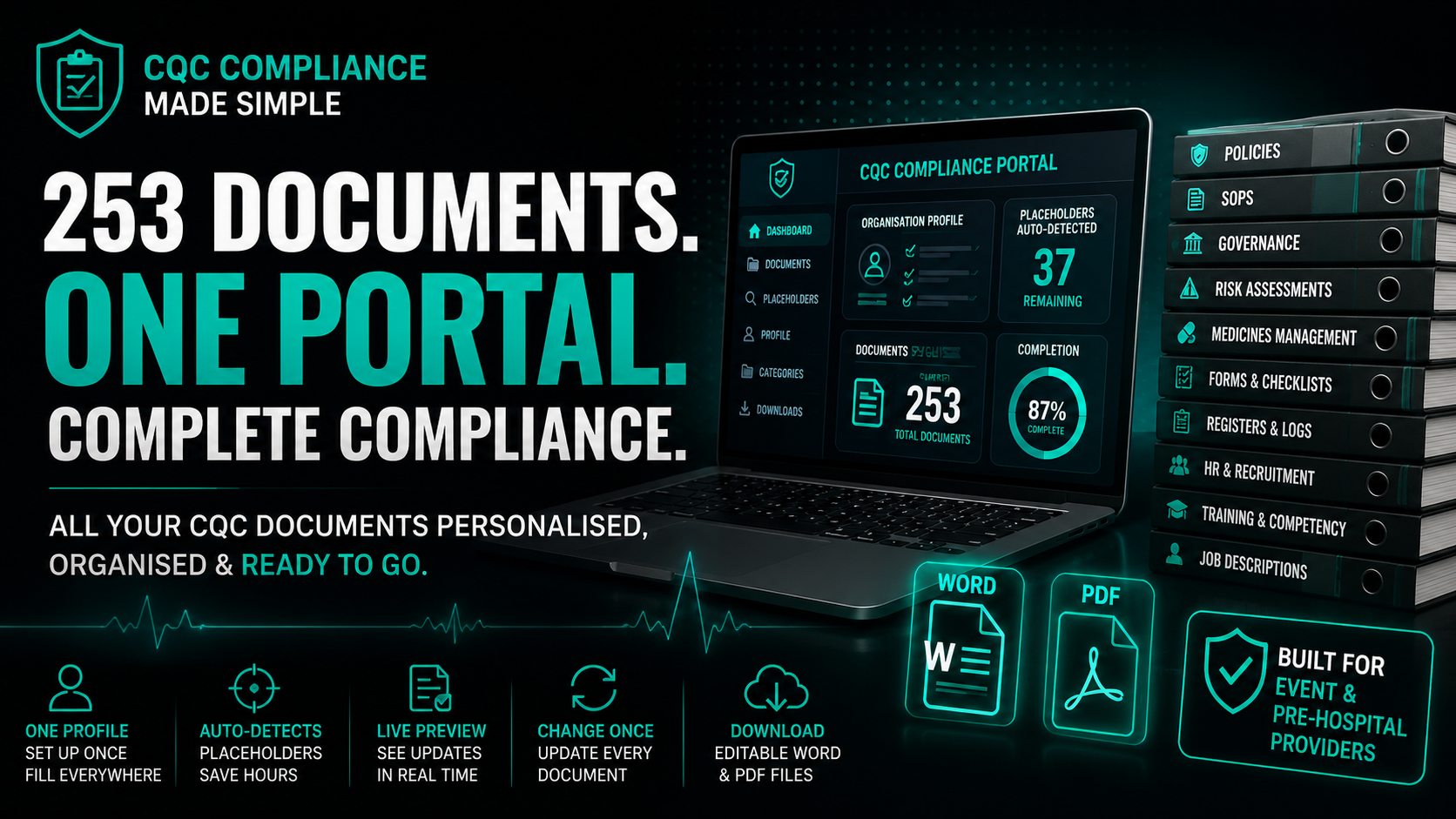
CQC Compliance Without the Document Headache: Introducing Our 253-Document Compliance Suite & Portal
Preparing for CQC registration can mean building and personalising hundreds of policies, SOPs, governance documents, risk assessments, forms, registers and workforce records. Our CQC Compliance Suite combines 253 professional documents with a purpose-built online portal that helps personalise your entire library from one organisation profile.
 Compliance & Governance
New CQC Registration for Event Medical Companies: What Every Provider Needs to Know Before September 2026
From 7 September 2026, event medical providers can apply for CQC registration. Here's what's changing, the key dates, and how to prepare your governance — without the consultancy price tag.
 Clinical
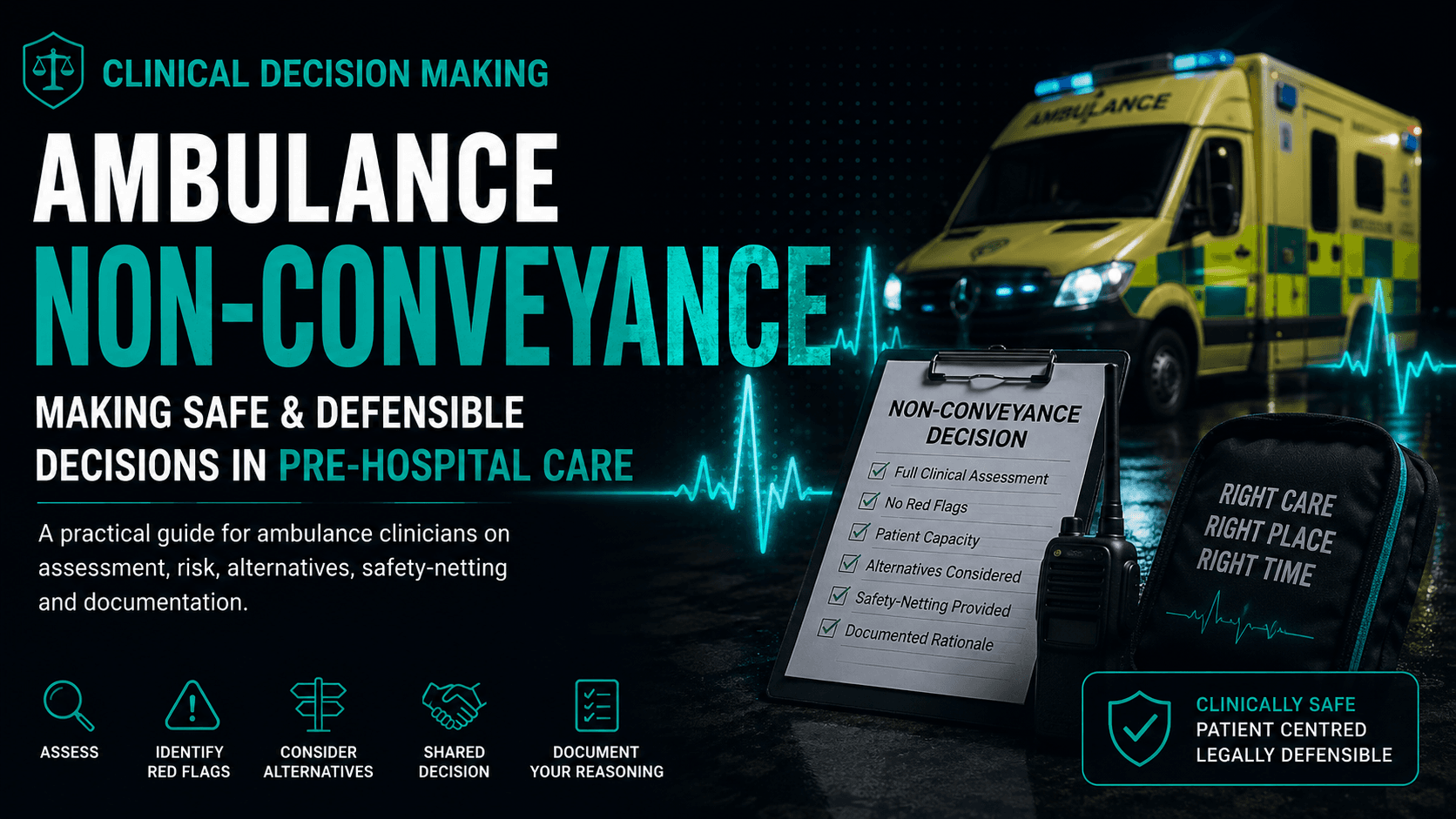
Ambulance Non-Conveyance: Making Safe, Defensible Decisions in Pre-Hospital Care
Non-conveyance has become an increasingly important part of modern UK ambulance practice. With growing pressure across urgent and emergency care, ambulance clinicians are increasingly expected to identify patients who can safely receive care closer to home or through alternative pathways.