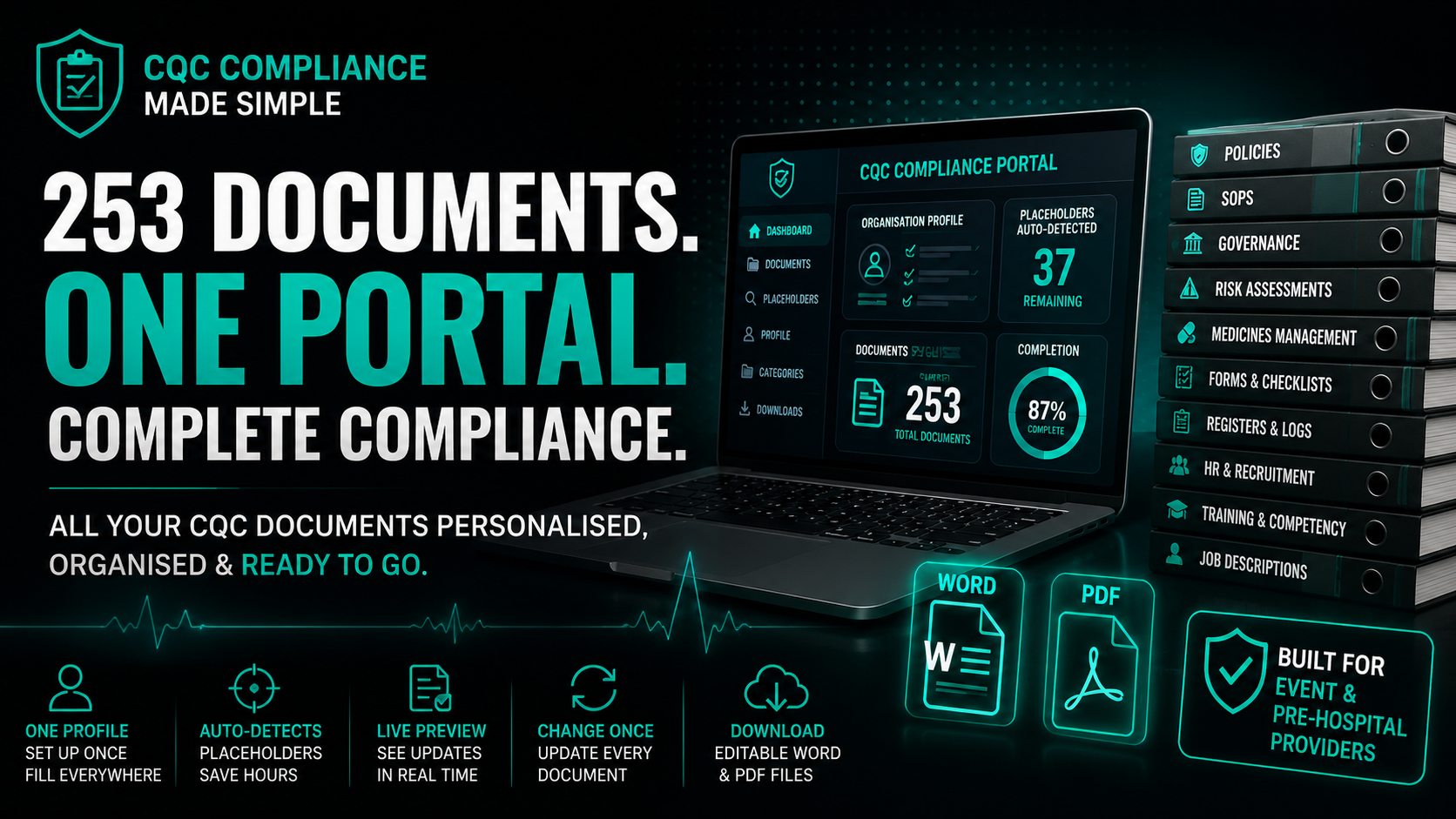
CQC Compliance Without the Document Headache: Introducing Our 253-Document Compliance Suite & Portal
Preparing for CQC registration can mean building and personalising hundreds of policies, SOPs, governance documents, risk assessments, forms, registers and workforce records. Our CQC Compliance Suite combines 253 professional documents with a purpose-built online portal that helps personalise your entire library from one organisation profile.
Preparing for CQC registration can mean building and personalising hundreds of policies, SOPs, governance documents, risk assessments, forms, registers and workforce records. Our CQC Compliance Suite combines 253 professional documents with a purpose-built online portal that helps personalise your entire library from one organisation profile.
253 Documents. How Do You Actually Personalise Them All?
For an event healthcare provider preparing for CQC registration, documentation can quickly become one of the largest parts of the process.
It's not simply a case of writing a safeguarding policy, medicines policy and a few SOPs.
A comprehensive compliance library can include:
Policies.
Standard Operating Procedures.
Clinical governance.
Quality assurance and audit.
Risk assessments.
Medicines management.
Forms and checklists.
Logs and registers.
Training records.
Recruitment documentation.
Competency frameworks.
Job descriptions.
Role profiles.
And much more.
Our own CQC Registration Guide for Event Healthcare identifies documentation across corporate, clinical governance, workforce and event-specific areas — from safeguarding and medicines management through to competency registers, event medical plans, major incident procedures and temporary-premises assessments.
That's why we created something more comprehensive than a small bundle of policies.
The CQC Compliance Suite
The Pre-Hospital Classroom CQC Compliance Suite contains 253 professional documents across 10 categories, designed for UK independent ambulance and pre-hospital providers.
The library covers:
Company Setup & Registration Governance, Quality & Clinical Audit Policies Standard Operating Procedures Medicines Management Risk Assessments Forms, Checklists & Logs Registers & Trackers HR, Training & Recruitment Job Descriptions & Role Profiles
But creating the documents only solved half of the problem.
Because once you've got 253 documents, there's another question:
Who's going to personalise all of them? The Problem With Manual Personalisation
Imagine receiving a library containing more than 250 documents.
Each relevant document may need information such as your:
Legal company name Registered address Responsible Person Registered Manager Nominated Individual Clinical Lead Safeguarding Lead CQC Provider ID CQC Location ID Contact details Document-control information
If you're doing that manually, you're potentially opening hundreds of Word documents one by one.
Search.
Replace.
Save.
Close.
Open the next one.
Repeat.
And repeat.
And repeat.
As Section 10 of our Event Healthcare Registration Guide explains, with around 250 documents this can become days of repetitive find-and-replace work — with the additional risk that somewhere within the library a placeholder gets missed.
That's exactly why we built the second half of our compliance package.
Introducing the CQC Compliance Portal
The Pre-Hospital Classroom CQC Compliance Portal has been developed to make personalising a large compliance library significantly easier.
Rather than repeatedly entering the same organisation information into hundreds of documents:
You enter it once.
The portal holds your organisation profile and uses that information throughout the documents that require it.
According to the workflow detailed in our provider guide, information such as your legal name, registered address, CQC IDs, contact information, logo and named organisational leads can be entered once and flowed into the relevant documents automatically.
One profile. 253 documents.
That's the principle behind the system.
An 11-Step Organisation Setup
When you first access the portal, you're taken through a guided organisation setup.
The system collects the information needed to begin personalising your document library.
Rather than asking for the same information every time you open another document, your central organisation profile becomes the source for information used throughout the package.
The portal workflow uses 11 guided setup steps, after which the system can begin applying those details throughout the library.
This transforms the initial process from:
Open → Find → Replace → Save → Repeat 250+ times
into:
Setup → Automatically Populate → Complete → Review → Generate Automatic Placeholder Detection
This is one of the most important features of the portal.
Our documents contain placeholders where information needs to be personalised.
The portal is designed to detect and track those placeholders across the document library.
That means you're not expected to remember where every company name, clinical lead, address or organisation-specific field appears.
The portal identifies outstanding fields and allows you to see what information is still required before a document is complete.
This is particularly valuable when dealing with hundreds of documents.
Because manually personalising 253 documents isn't just about the time involved.
It's about consistency.
It Goes Beyond Changing Your Company Name
We didn't want the portal to simply perform a glorified mail merge.
Proper personalisation goes further than replacing:
[INSERT COMPANY NAME]
with:
Your Medical Company Ltd
Some documents require information that only you can provide.
Your service description.
Your objectives.
Your organisational arrangements.
Your mission statement.
Your responsibilities.
Your operational decisions.
The portal therefore allows document-specific information to be completed as well.
Fixed responses such as Yes/No, Red/Amber/Green and Pass/Fail/N/A can also be handled through structured choices rather than repeatedly typing responses manually.
That's important because your documentation should describe your organisation, not somebody else's.
See Your Document While You Complete It
Another feature built into the portal is live document preview.
As you work through the required information, you can see how those details appear within the actual document.
Fields update as they're completed, giving you a much clearer picture of how the finished document will read.
Instead of filling out a long form and hoping everything appears in the correct place afterwards, you can see the document taking shape while you work.
Know Exactly What Still Needs Completing
With a large compliance library, organisation matters.
You don't want to be asking:
"Have I finished the medicines documents?"
"Did we complete that risk assessment?"
"Was the Clinical Lead added to this policy?"
"Which documents still need information?"
The portal is designed to make outstanding information visible.
Each document can show what still needs completing — or indicate that it's Ready once the required information has been dealt with.
This gives you a much clearer path through what would otherwise be an enormous folder of files.
Change One Detail. Update Everywhere.
Here's another problem providers can encounter.
You've spent days personalising your library.
Then your Clinical Lead changes.
Or you move premises.
Or your Registered Manager changes.
Without a central system, you now need to identify every document containing that person's name or the old information.
With our portal, central organisation details can be changed and the relevant documents regenerated.
Change once. Regenerate your library.
The portal was specifically designed around this problem, allowing central details to be updated rather than requiring the provider to manually hunt through hundreds of documents.
For an organisation that continues developing during its registration journey, that's a major advantage.
Fully Editable Documents
Automation shouldn't mean locking you into our system.
Once generated, your documents remain genuinely editable.
The package provides editable Word and PDF documents, organised by category and versioned within the portal. Providers can also add their own existing documents so their wider compliance library can be kept together.
That means you can continue adapting documentation as your organisation develops.
Because no two providers operate exactly the same way.
More Than Policies
One of the reasons we've built such a large library is because good governance isn't demonstrated by policies alone.
Imagine your policy says:
"All clinical incidents will be reviewed through the organisation's governance process."
Great.
Where is your incident register?
Where is your investigation documentation?
Where are your governance meeting records?
Where is the action plan?
Where is your audit?
Where is the evidence that learning actually occurred?
CQC's fundamental standards include Regulation 17 — Good Governance, and our Event Healthcare Registration Guide specifically highlights records, audit, risk and learning in the event context.
That's why the Compliance Suite goes beyond policies and includes the practical supporting documents needed to help providers build their wider governance systems.
Built With Event & Pre-Hospital Providers in Mind
Event healthcare isn't a hospital ward.
Providers can be operating from:
Temporary medical centres.
Treatment tents.
Ambulances.
Response vehicles.
Stadium medical rooms.
Festivals.
Sporting venues.
Remote event sites.
This creates very different governance challenges.
How do you maintain dignity inside a temporary treatment structure?
How do you manage infection prevention and control?
How do you demonstrate equipment readiness?
How do you manage fatigue during long event days?
How do you escalate patients into NHS services?
How do you demonstrate the competence of a clinical team assembled from employed, bank, agency or volunteer staff?
These are exactly the kinds of event-specific issues identified within our registration guide.
The package is therefore designed around the realities of UK independent ambulance and pre-hospital services, rather than treating event medicine as an afterthought.
From Purchase to Personalised Library
The idea behind the entire system is simple:
- Access your Compliance Suite
Your 253-document library is organised across 10 categories.
- Complete your organisation profile
Enter your common company and leadership information.
- Let the portal populate common information
Details are flowed into documents that use them.
- Complete outstanding placeholders
The portal identifies information that still requires your input.
- Review your documents
Use the document preview and ensure the content accurately reflects your service.
- Generate your personalised documents
Create your completed versions.
- Download and continue editing
Your documents remain editable.
- Implement them
This is the most important stage.
Because owning a policy isn't the same as following it.
The Portal Doesn't Run Your Governance For You
We think it's important to be clear about this.
Our package is designed to remove a huge amount of the document creation, administration and personalisation workload involved in building a compliance library.
It doesn't remove the provider's responsibility.
You still need to review the documents.
You still need to make sure they reflect your service.
You still need to train your staff.
You still need to undertake audits.
You still need to hold governance meetings.
You still need to maintain registers.
And you still need to demonstrate that the processes described within your documentation happen in practice.
Our own guide makes this distinction particularly well: professionally written starting documentation isn't the problem; failing to properly personalise documents to your organisation and actual operating model is.
The portal is there to make that personalisation considerably easier.
253 Documents. 10 Categories. One Portal.
The Full CQC Compliance Suite currently includes:
253 professional documents 10 compliance categories Personalisation through our online portal Editable Word & PDF documents Unlimited downloads Future package updates Priority support
The package is currently listed in our provider guide at £499.99.
Instead of spending weeks building hundreds of documents from a blank page and then manually personalising every file, we've created a system designed to get you to the important part faster:
Reviewing, implementing and evidencing your governance systems. Get CQC Ready Before The Rush
For event healthcare providers affected by the new TDDI arrangements, registration applications are due to open on 7 September 2026.
Our guide identifies 1 March 2027 as the important practical submission date: CQC has said it will take all reasonable steps to provide an outcome by 6 December 2027 for complete applications received on or before that date.
So preparation time matters.
Don't spend it opening 253 Word documents and repeatedly pressing Find & Replace.
Use that time to build the organisation behind them.
253 documents. One organisation profile. One CQC Compliance Portal.
Get CQC Ready Before The Rush. Key Takeaways
Our CQC Compliance Suite contains 253 documents across 10 categories, covering far more than policies alone. The accompanying portal is designed to detect and track placeholders, automatically populate common organisation information across relevant documents, allow document-specific information to be completed, provide live previews, and regenerate documents when central details change.
The result is a system designed to reduce the repetitive administrative workload involved in creating and personalising a large compliance library — while keeping the provider responsible for reviewing, adapting, implementing and maintaining the actual governance systems behind those documents.
Check Out Our CQC Compliance Page you will also find a free guide at the bottom of page to download:
https://www.theprehospitalclassroom.co.uk/portal
Compliance Disclaimer
The Pre-Hospital Classroom CQC Compliance Suite and Portal are designed to support providers with the development, personalisation and management of their compliance documentation. They do not guarantee CQC registration or regulatory compliance. Providers remain responsible for ensuring documentation accurately reflects their organisation, regulated activities, scope of practice and operating model, and for implementing and maintaining the systems described within their documents.
Clinical insights, straight to your inbox
Get new articles, CPD tips and product updates. No spam — unsubscribe anytime.
Related articles
 Compliance & Governance
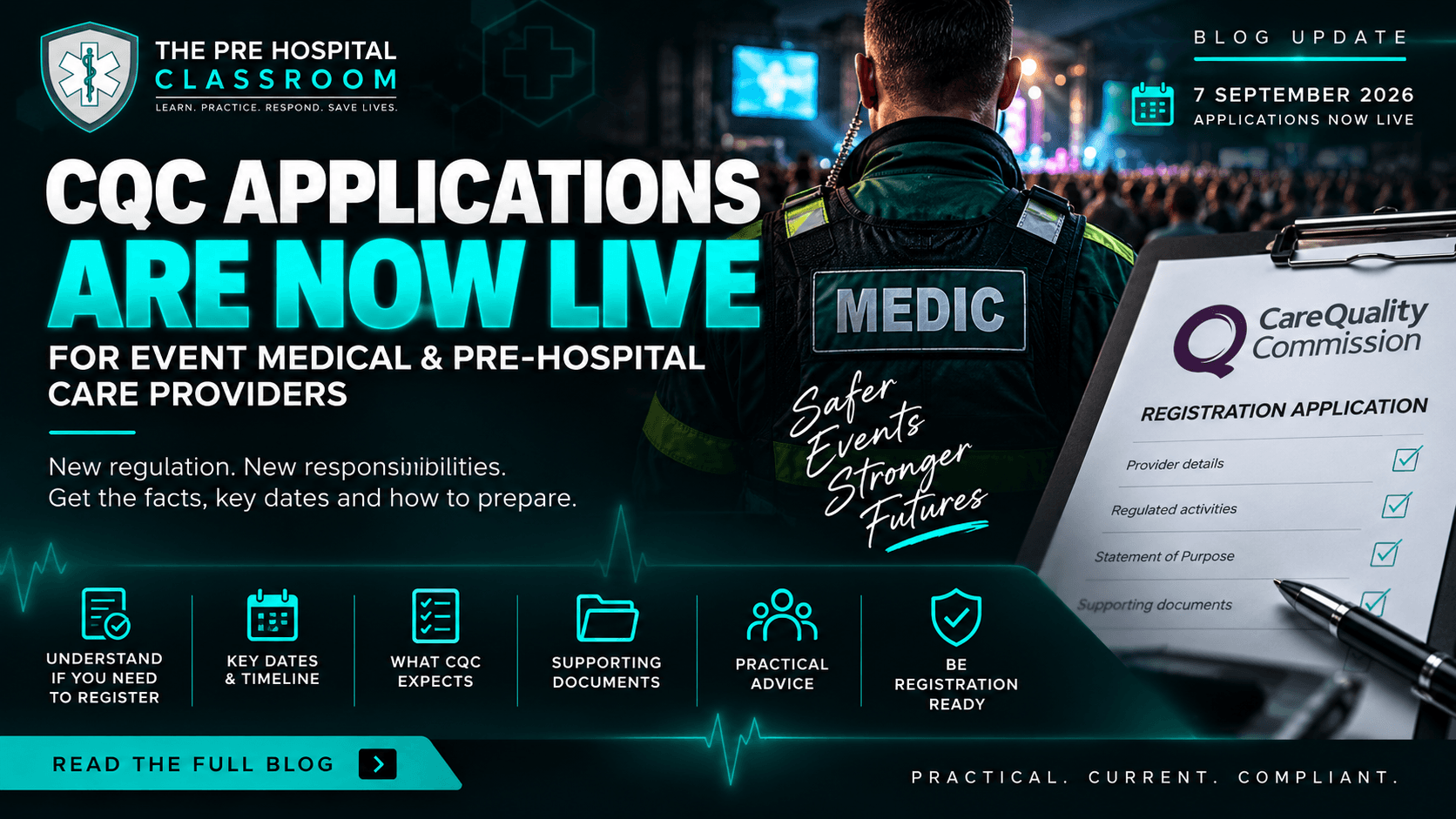
CQC Applications Are Now LIVE for Event Medical Providers: What You Need to Know
From 7 September 2026, providers delivering healthcare and treatment at sporting and cultural events that meets the definition of the regulated activity Treatment of Disease, Disorder or Injury (TDDI) can begin submitting their applications to the Care Quality Commission.
 Compliance & Governance
New CQC Registration for Event Medical Companies: What Every Provider Needs to Know Before September 2026
From 7 September 2026, event medical providers can apply for CQC registration. Here's what's changing, the key dates, and how to prepare your governance — without the consultancy price tag.
 Clinical
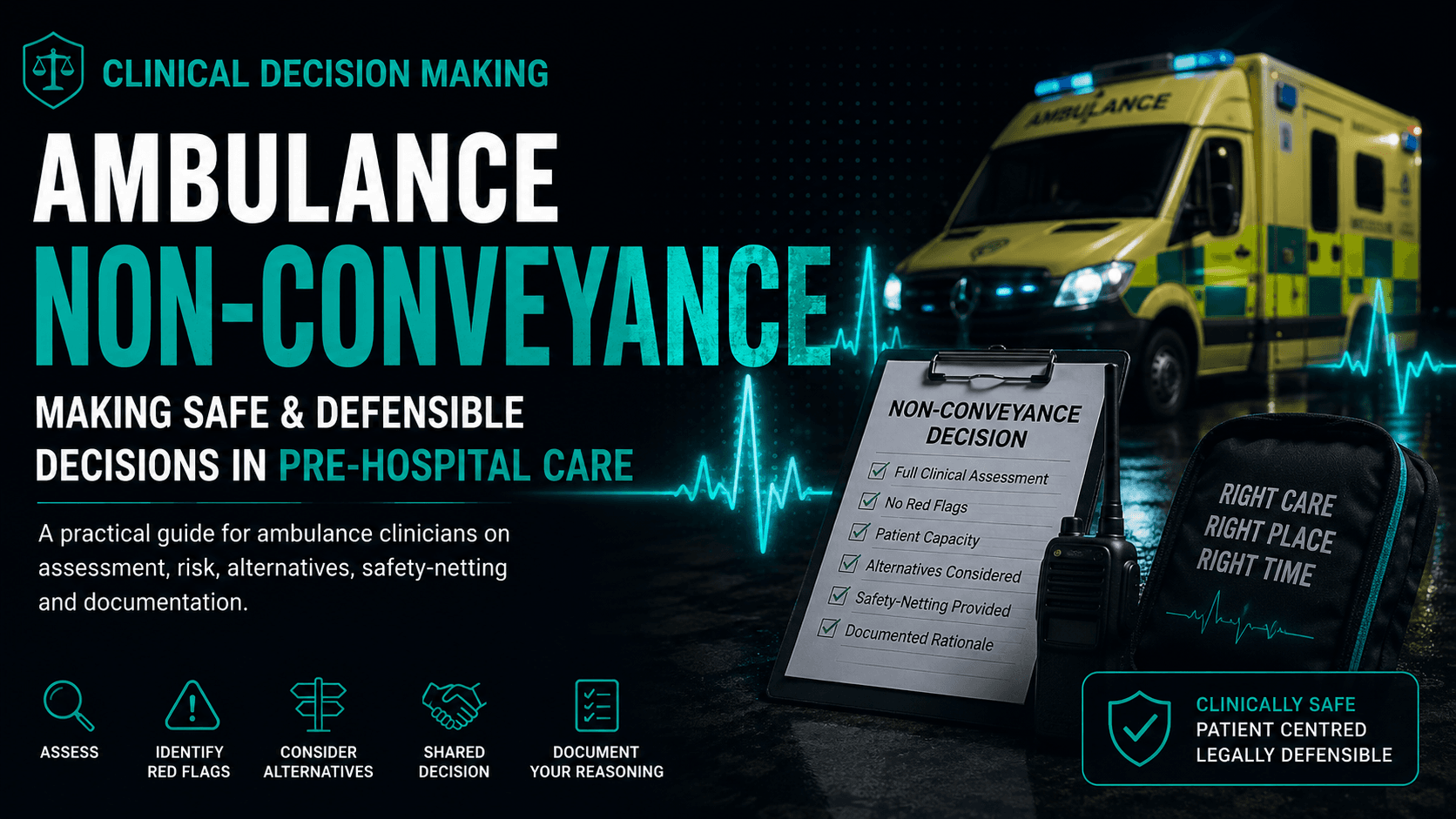
Ambulance Non-Conveyance: Making Safe, Defensible Decisions in Pre-Hospital Care
Non-conveyance has become an increasingly important part of modern UK ambulance practice. With growing pressure across urgent and emergency care, ambulance clinicians are increasingly expected to identify patients who can safely receive care closer to home or through alternative pathways.