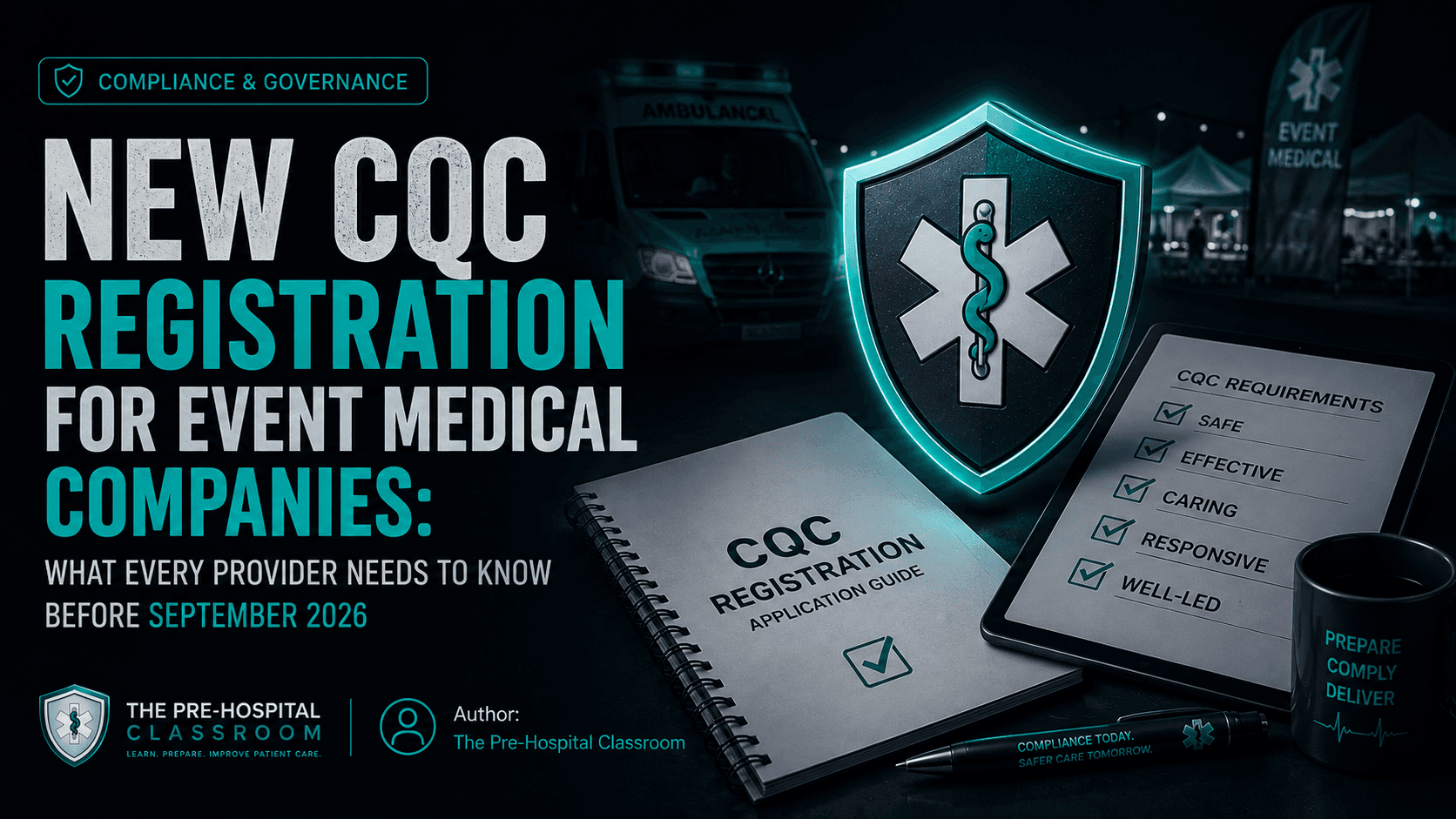
New CQC Registration for Event Medical Companies: What Every Provider Needs to Know Before September 2026
From 7 September 2026, event medical providers can apply for CQC registration. Here's what's changing, the key dates, and how to prepare your governance — without the consultancy price tag.
The Biggest Regulatory Change the Event Medical Industry Has Seen
For years, many event medical providers have operated outside the scope of CQC regulation when delivering healthcare at sporting and cultural events. That is about to change.
Following recommendations from the Manchester Arena Inquiry, the Government has removed the legislative exemptions that previously kept many event healthcare providers outside the Care Quality Commission's regulatory framework. From 7 September 2026, eligible providers can begin applying for CQC registration for the regulated activity Treatment of Disease, Disorder or Injury (TDDI).
If your company provides clinical treatment at festivals, sporting events, concerts or other temporary event sites, these changes could directly affect your business.
The reality is simple:
Clinical governance is no longer optional. It will become a legal expectation.
What Has Actually Changed?
Previously, there were specific legal exemptions covering healthcare delivered at sporting and cultural events. Those exemptions have now been removed.
If your organisation carries out the regulated activity of Treatment of Disease, Disorder or Injury (TDDI) at event sites, you will need to be registered with CQC.
This is one of the most significant changes to event medicine regulation in decades.
Key Dates
- 7 September 2026 — Providers can begin submitting CQC registration applications.
- 1 March 2027 — Applications submitted by this date (and complete on submission) are expected to be processed before regulation begins.
- 6 December 2027 — CQC will begin regulating event medical providers. Delivering the regulated activity without registration from this date may be an offence.
This Isn't Just About Filling in an Application
Many providers believe CQC registration is simply paperwork. It isn't.
Registration is actually the easy part. Maintaining compliance is where the work begins.
CQC wants to see evidence that governance exists throughout your organisation — not just documents sitting in a folder. That means demonstrating that your systems are embedded into daily practice.
The Compliance Burden
Most event medical companies will need to review or create documentation covering areas such as:
- Statement of Purpose
- Clinical Governance Framework
- Clinical Audit Programme
- Incident Reporting Policy
- Duty of Candour Policy
- Complaints Policy
- Safeguarding Adults Policy
- Safeguarding Children Policy
- Infection Prevention & Control Policy
- Medicines Management Policy
- Medical Gases Policy
- Patient Group Direction governance (where applicable)
- Clinical Record Keeping Policy
- Information Governance & GDPR
- Consent Policy
- Mental Capacity Act Policy
- Equality & Diversity Policy
- Recruitment Policy
- DBS Procedures
- Staff Induction SOP
- Mandatory Training Matrix
- Competency Framework
- Clinical Supervision Policy
- Lone Working Policy
- Escalation Procedures
- Major Incident SOP
- Vehicle & Equipment Checking SOP
- Daily Operational SOPs
- Clinical Equipment Management
- Risk Register
- Business Continuity Plan
- Fire Safety
- Health & Safety Management
- Infection Cleaning SOPs
- Controlled Drugs Governance (where applicable)
- Learning from Incidents Process
- Quality Improvement Programme
- Document Control System
- Version Control
- Policy Review Schedule
…and that's before considering operational forms, audit templates, competency documents and governance meetings.
Standard Operating Procedures Matter
Policies explain what your organisation expects. Standard Operating Procedures (SOPs) explain how staff actually do it.
A mature governance system usually includes SOPs covering areas such as:
- Opening an event medical centre
- Closing procedures
- Patient assessment
- Escalation pathways
- Documentation standards
- Handover procedures
- Drug administration
- Oxygen therapy
- Equipment failures
- Incident reporting
- Radio communications
- Major incidents
- Missing persons
- Safeguarding referrals
- Ambulance requests
- Patient transport
- Infection control
- Vehicle checks
- Kit replenishment
Without consistent SOPs, even good clinicians can end up working differently from one another. Consistency is one of the foundations of safe healthcare.
Policies Alone Won't Impress CQC
Having hundreds of documents isn't enough. Inspectors are interested in whether your organisation actually follows them.
That means being able to demonstrate:
- Staff training
- Competency assessments
- Audit activity
- Governance meetings
- Clinical learning
- Incident investigations
- Quality improvement
- Evidence of continual review
- Leadership oversight
- Version-controlled documentation
Good governance is an ongoing process, not a one-time exercise.
The Consultancy Route Can Become Very Expensive
Many organisations choose to work with external CQC consultants. That approach can work well, but costs can quickly add up.
Typical consultancy support may include:
- Registration assistance
- Policy writing
- SOP development
- Governance advice
- Statement of Purpose drafting
- Compliance reviews
- Mock inspections
- Ongoing consultancy retainers
Depending on the level of support required, costs can easily reach several thousand pounds over the course of the registration process and beyond. For smaller providers and new event medical companies, those costs can become a significant barrier.
A Different Approach
At The Pre-Hospital Classroom, we've built a solution specifically for event medical providers. Rather than charging consultancy rates, we've created a complete compliance package designed to help organisations build a professional governance framework from day one.
Our CQC Compliance Package — £499
For a single fixed price, you'll receive access to a comprehensive compliance system through our online portal.
The package includes:
- Complete Policy Library — professionally written policy templates covering the core areas expected within a modern healthcare provider.
- SOP Library — operational procedures designed specifically for event medical services.
- Governance Documents — templates for clinical audits, incident reporting, governance meetings, risk registers, action plans, competency assessments and quality improvement.
- Compliance Portal — everything organised in one secure portal, making it easier to manage documentation, updates and ongoing compliance.
- Editable Documents — no locked PDFs. Everything is designed so you can tailor documents to your own organisation.
- Ready-to-Use Templates — helping reduce the time spent creating documentation from scratch.
Why We Built It
We know what it's like. Writing hundreds of pages of governance documentation isn't why people start event medical companies.
You want to provide excellent patient care — not spend months staring at Microsoft Word.
We've done the heavy lifting so you can spend more time focusing on patients, staff development and growing your organisation.
Compliance Shouldn't Cost Thousands
The new regulations represent a positive step forward for patient safety and professional standards across the event medical sector. They will, however, raise expectations around governance, leadership and clinical quality.
Preparing early will put your organisation in a much stronger position before registration opens in September 2026. Whether you're a new provider or an established event medical company, investing in robust policies, SOPs and governance systems now will save considerable time — and stress — later.
Ready to Prepare for CQC?
Our Event Medical CQC Compliance Package includes:
- Comprehensive policy library
- Standard Operating Procedures
- Governance templates
- Editable documents
- Compliance portal
- Regular updates
One-off price: £499
Build your governance framework with confidence and be ready for the next chapter of event medical regulation.
Disclaimer: This article is intended as general information and should not be taken as legal or regulatory advice. Providers should always refer to the latest Care Quality Commission guidance and legislation when determining whether registration applies to their specific services.
Clinical insights, straight to your inbox
Get new articles, CPD tips and product updates. No spam — unsubscribe anytime.
Related articles
 Compliance & Governance
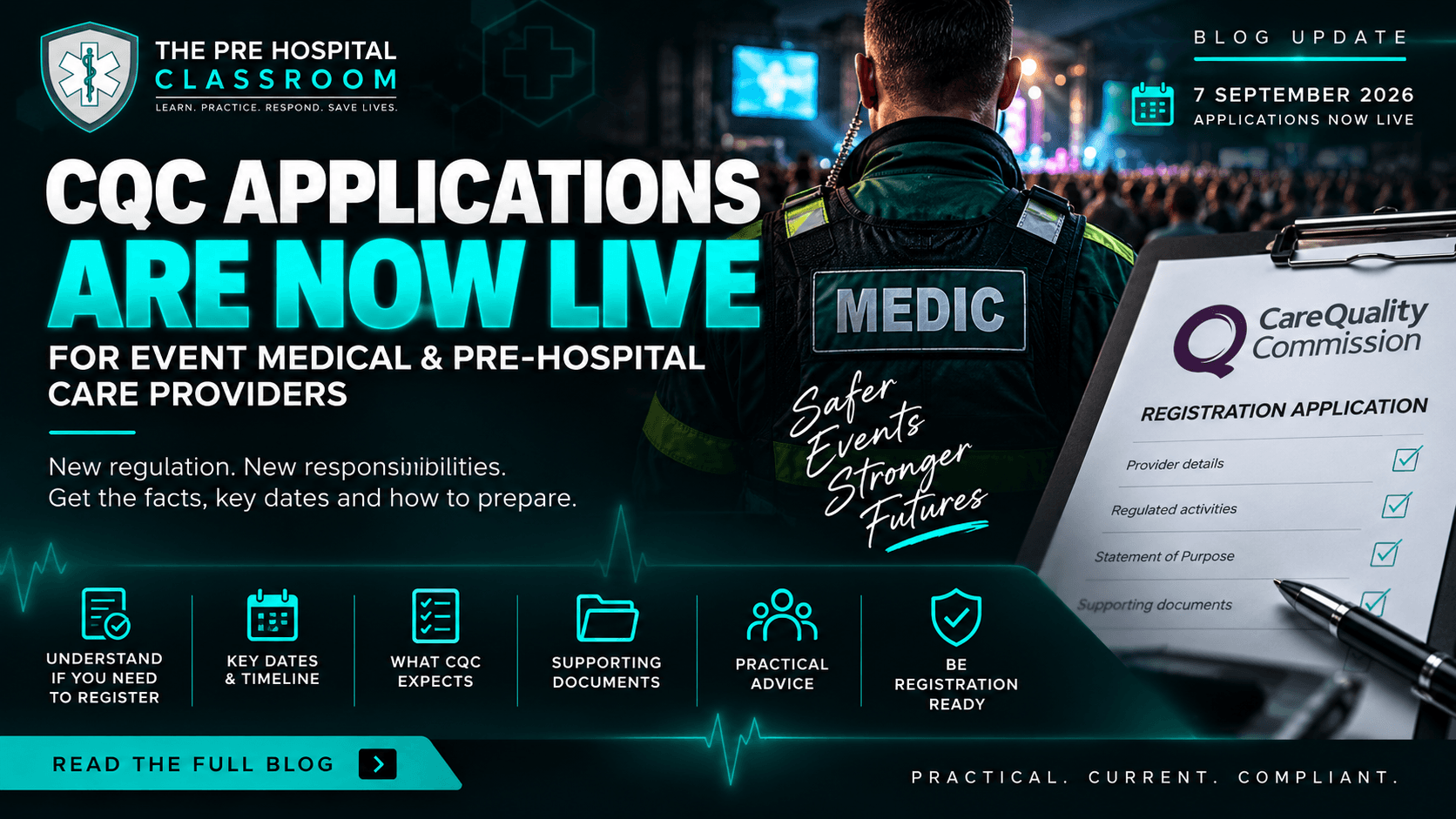
CQC Applications Are Now LIVE for Event Medical Providers: What You Need to Know
From 7 September 2026, providers delivering healthcare and treatment at sporting and cultural events that meets the definition of the regulated activity Treatment of Disease, Disorder or Injury (TDDI) can begin submitting their applications to the Care Quality Commission.
 Compliance & Governance
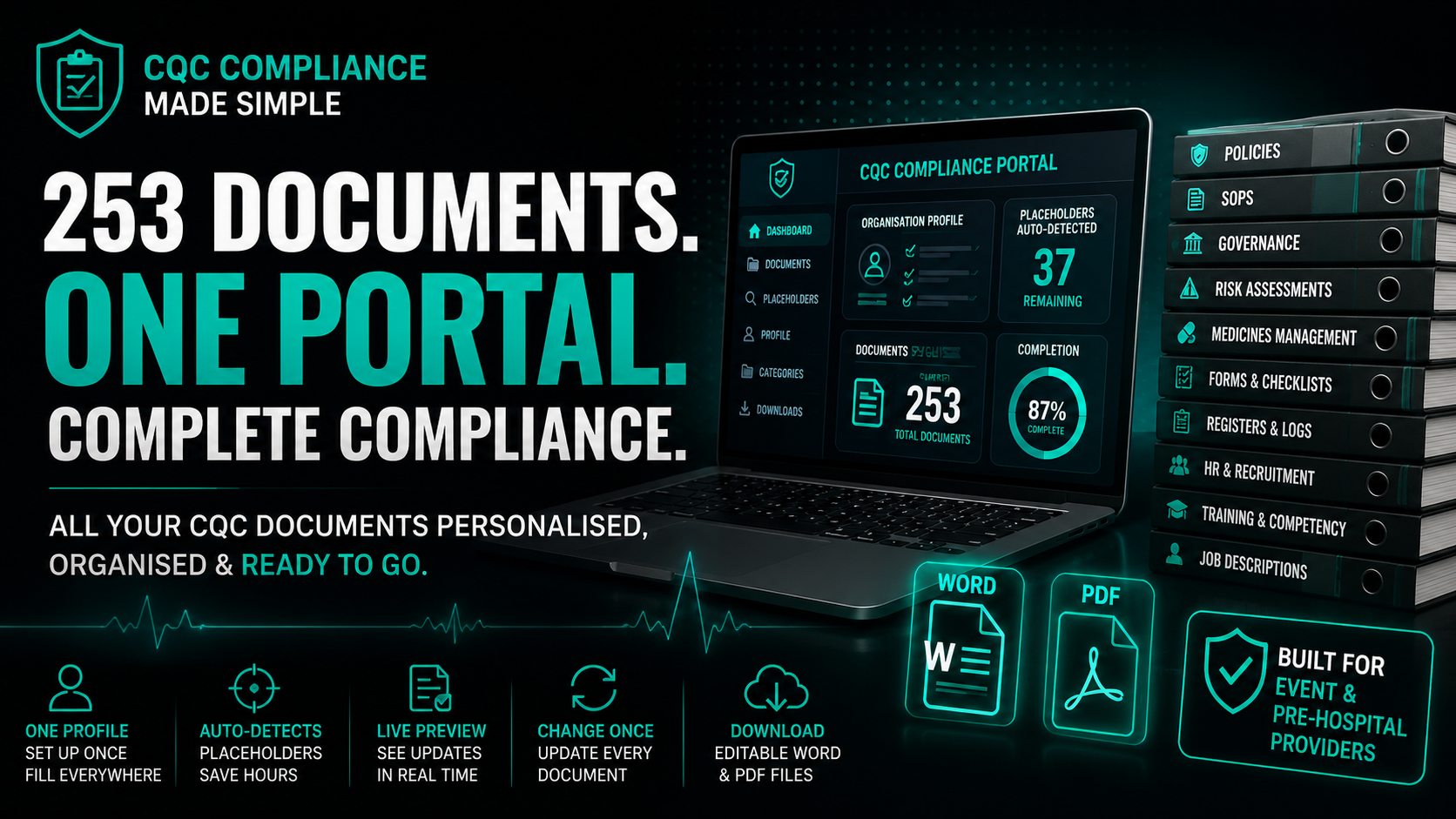
CQC Compliance Without the Document Headache: Introducing Our 253-Document Compliance Suite & Portal
Preparing for CQC registration can mean building and personalising hundreds of policies, SOPs, governance documents, risk assessments, forms, registers and workforce records. Our CQC Compliance Suite combines 253 professional documents with a purpose-built online portal that helps personalise your entire library from one organisation profile.
 Clinical
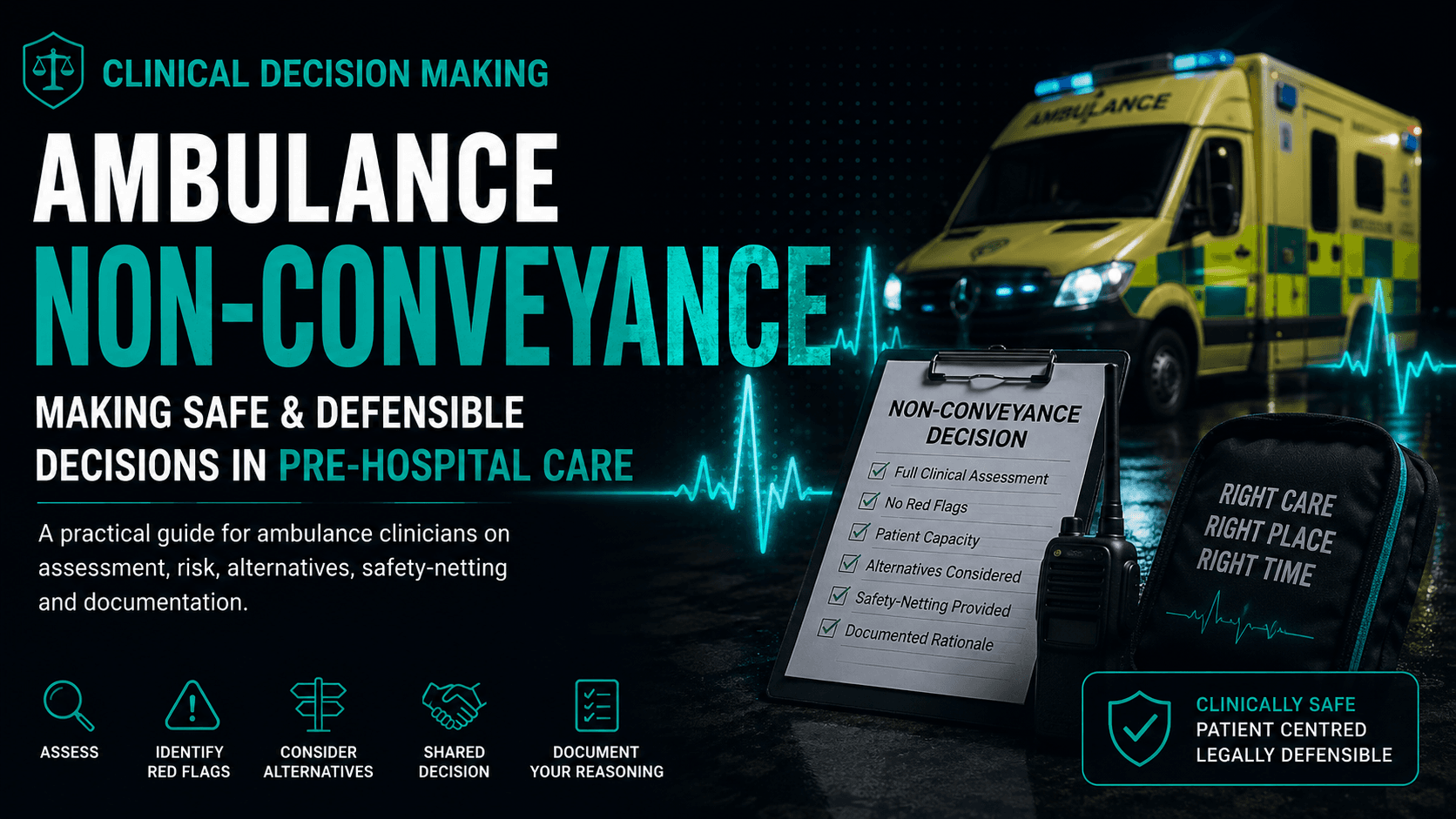
Ambulance Non-Conveyance: Making Safe, Defensible Decisions in Pre-Hospital Care
Non-conveyance has become an increasingly important part of modern UK ambulance practice. With growing pressure across urgent and emergency care, ambulance clinicians are increasingly expected to identify patients who can safely receive care closer to home or through alternative pathways.