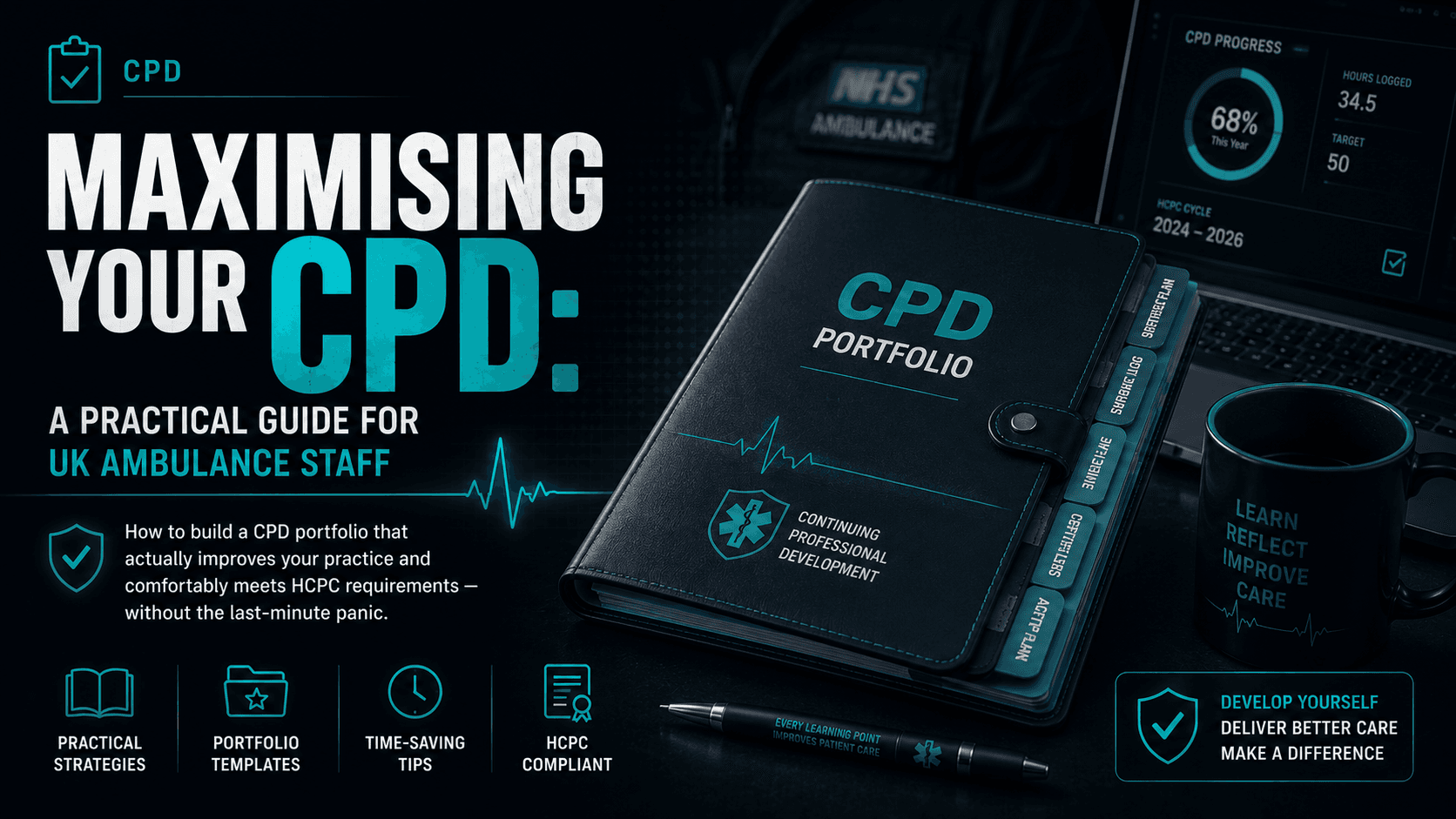
Maximising Your CPD: A Practical Guide for UK Ambulance Staff
How to build a CPD portfolio that actually improves your practice and comfortably meets HCPC requirements — without the last-minute panic.
Continuing Professional Development (CPD) is a registration requirement — but treated well, it's also the single best way to keep your practice sharp. Here's how to make it work for you rather than against you.
What the HCPC actually expects
Registrants must maintain a continuous, up-to-date and accurate record of CPD, and be able to show that it has contributed to the quality of their practice and benefited service users. You don't need a fixed number of hours — you need evidence of learning and its impact.
What counts as CPD
CPD is much broader than formal courses. It includes:
- Work-based learning — reflective practice, case reviews, clinical supervision, mentoring.
- Professional activity — teaching, presenting, being part of a working group.
- Formal education — courses, e-learning, conferences.
- Self-directed learning — reading guidelines, journals and evidence.
A varied portfolio is stronger than one built entirely from a single source.
Build the habit, not the backlog
The clinicians who never panic before an audit do three simple things:
- Log little and often. A few lines after an interesting job beats reconstructing a year from memory.
- Always add reflection. What did you learn, and what will you do differently? That link to practice is what the HCPC is looking for.
- Keep the evidence. Certificates, reflective notes, feedback — store them in one place.
CPD isn't about collecting certificates. It's about showing that your learning changed what you do.
Turn everyday work into CPD
That guideline update you reviewed, the debrief after a difficult job, the student you precepted — all of it is CPD if you record and reflect on it. Our membership and training resources are designed to give you structured, reflective learning you can log directly.
Start today: write two lines about something you learned this week and what you'll do with it. That's CPD — and it's genuinely making you better at the job.
Clinical insights, straight to your inbox
Get new articles, CPD tips and product updates. No spam — unsubscribe anytime.
Related articles
 Compliance & Governance
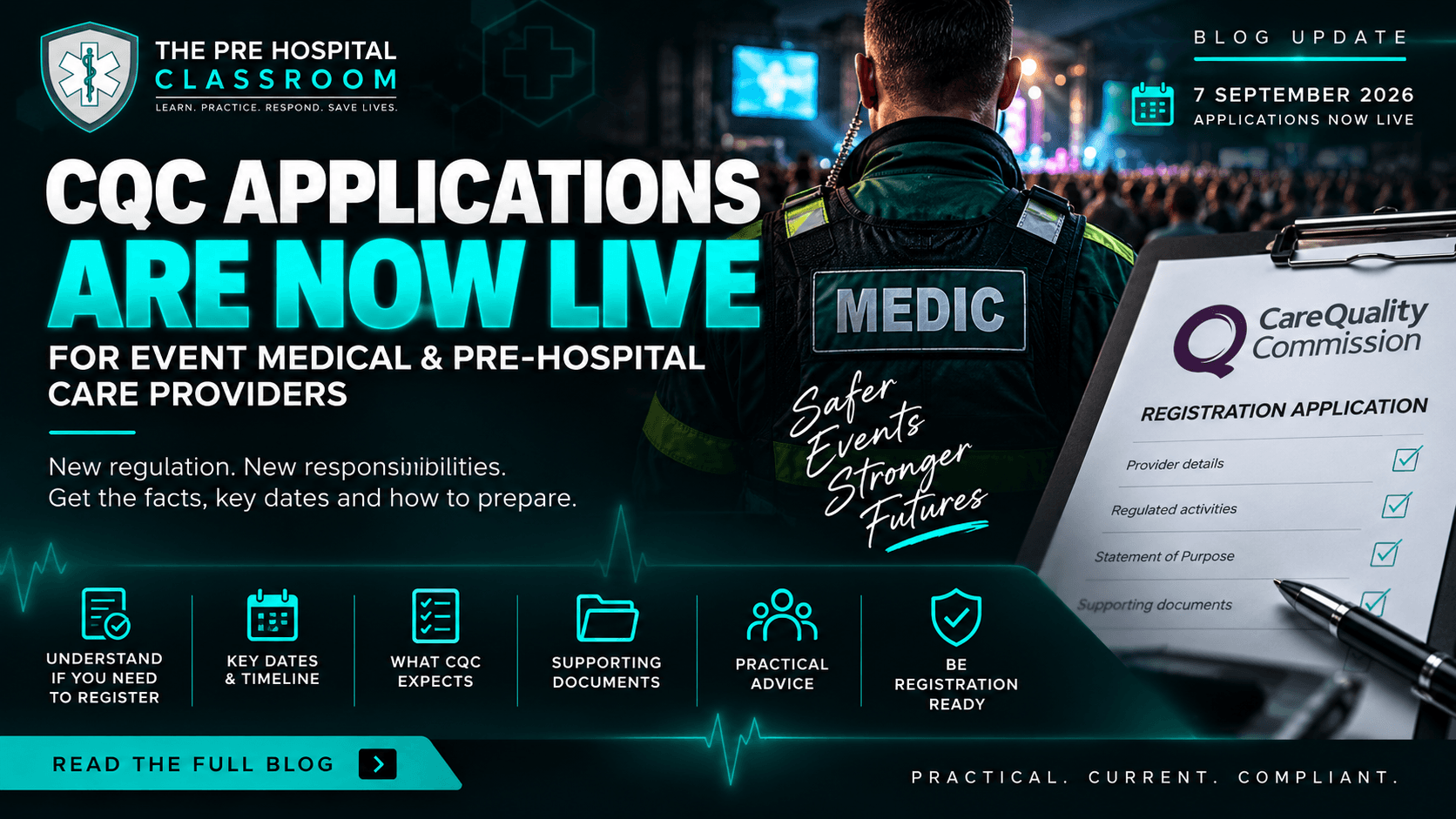
CQC Applications Are Now LIVE for Event Medical Providers: What You Need to Know
From 7 September 2026, providers delivering healthcare and treatment at sporting and cultural events that meets the definition of the regulated activity Treatment of Disease, Disorder or Injury (TDDI) can begin submitting their applications to the Care Quality Commission.
 Compliance & Governance
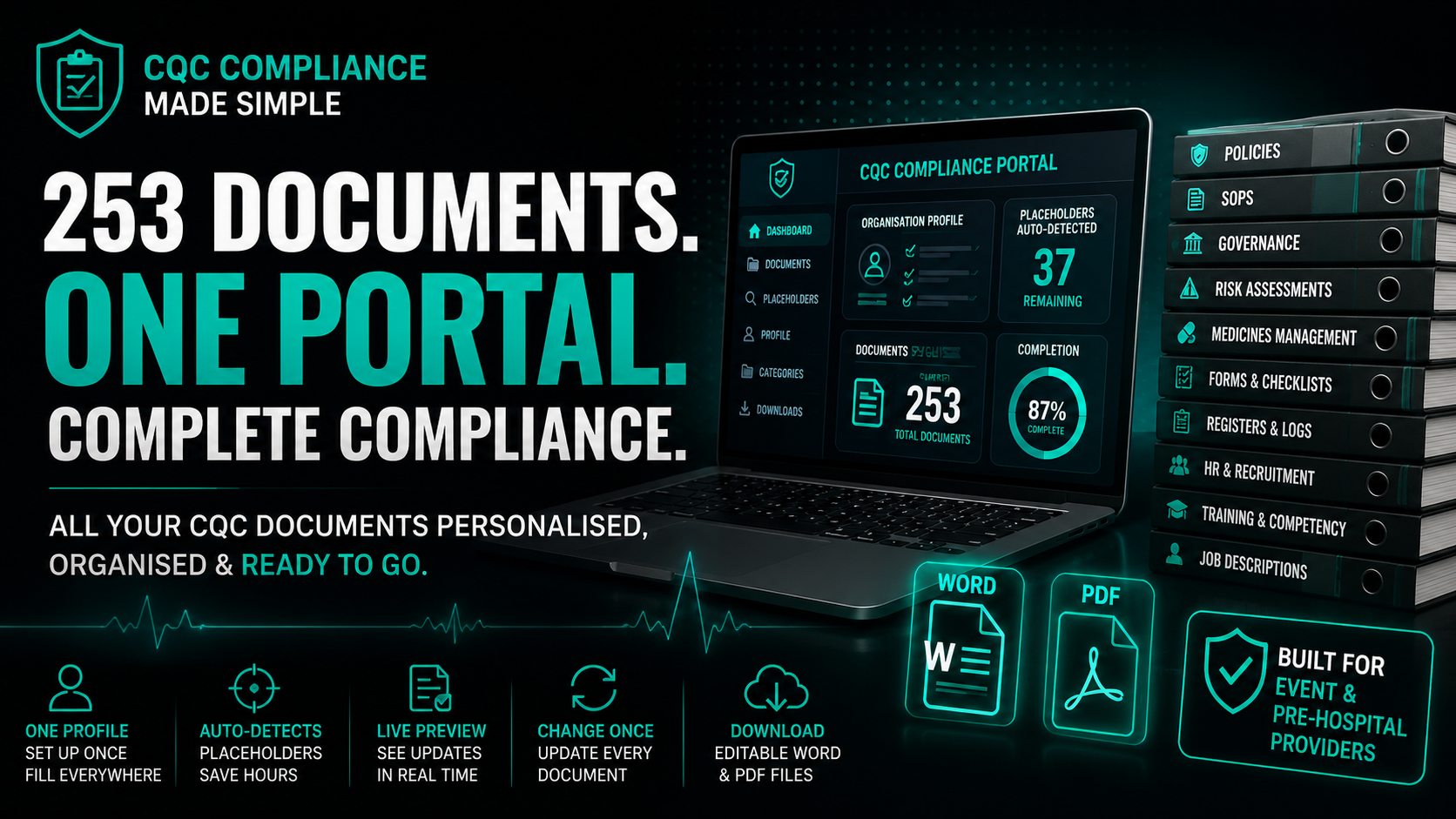
CQC Compliance Without the Document Headache: Introducing Our 253-Document Compliance Suite & Portal
Preparing for CQC registration can mean building and personalising hundreds of policies, SOPs, governance documents, risk assessments, forms, registers and workforce records. Our CQC Compliance Suite combines 253 professional documents with a purpose-built online portal that helps personalise your entire library from one organisation profile.
 Clinical
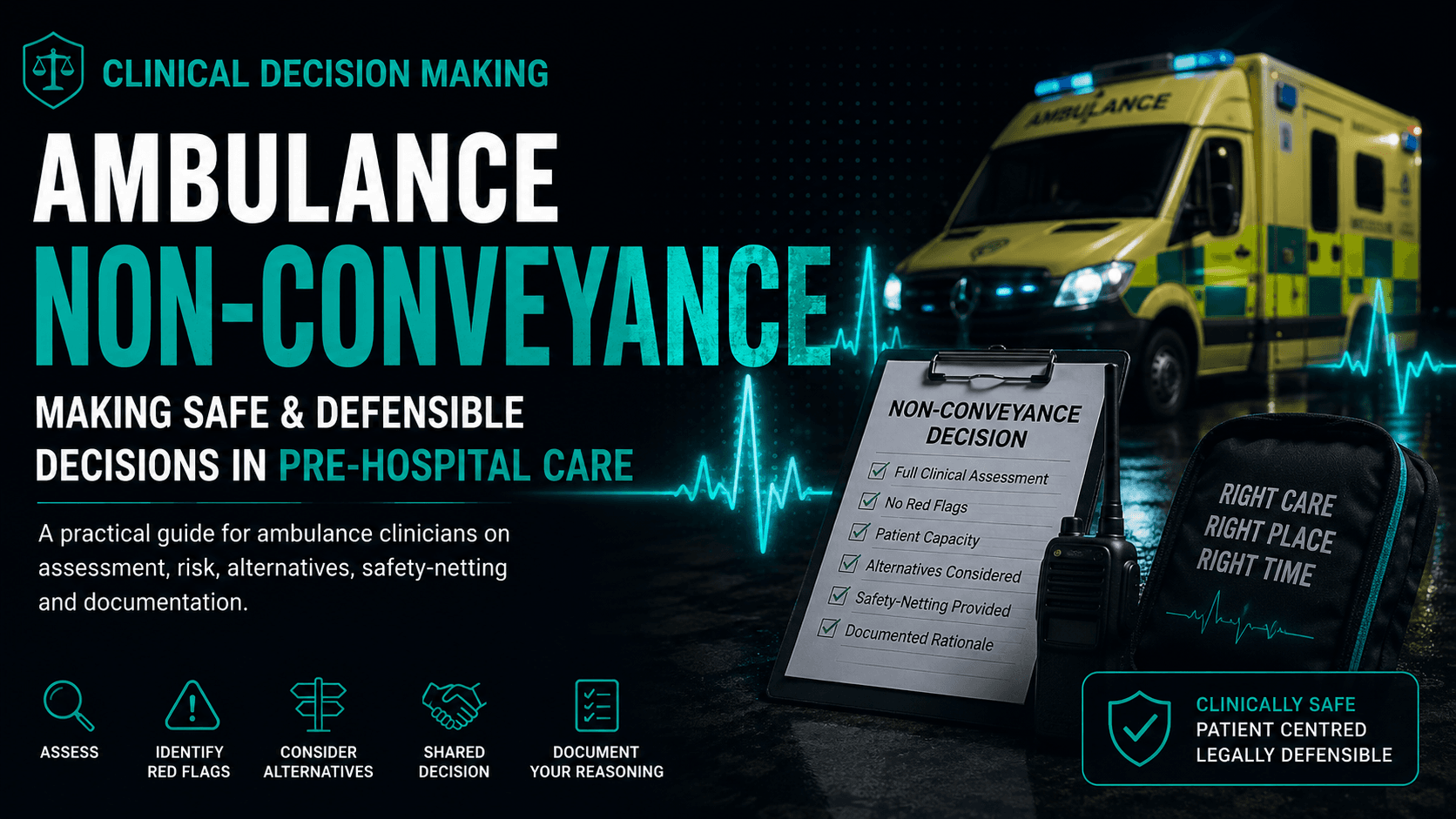
Ambulance Non-Conveyance: Making Safe, Defensible Decisions in Pre-Hospital Care
Non-conveyance has become an increasingly important part of modern UK ambulance practice. With growing pressure across urgent and emergency care, ambulance clinicians are increasingly expected to identify patients who can safely receive care closer to home or through alternative pathways.